
You launched a website. You hit publish. You waited.
Nothing happened.
That’s exactly where most small business websites start — showing up in Google searches, but not quite ranking high enough for anyone to actually click.
This guide uses a real client, Chai Craft USA (chaicraftusa.com), a chai café in Sunnyvale, California, to show you what the early stages of SEO actually look like — the numbers, the gaps, and what to do next.
No fluff. No “just create great content” advice without context. Just the honest version.
What SEO Actually Means for a Small Business
SEO — search engine optimisation — is really just one thing: making sure the right people can find your website when they search for what you offer.
That’s it. Everything else — keywords, backlinks, technical audits — is just the machinery underneath that one goal.
The reason it matters so much for small businesses is simple: you probably can’t afford to run paid ads indefinitely.
A Google Ads campaign stops working the minute you stop paying. SEO, done right, keeps working. A page you optimise today can bring in foot traffic and orders twelve months from now.
The catch is that it takes time. And most people underestimate how much time — which is why they give up too early, or convince themselves it doesn’t work.
It works. You just have to understand the game you’re playing before you start.
If you’re ready to build a proper plan, here’s a framework on creating an SEO strategy from scratch that’s worth reading alongside this guide.
The Case Study: Chai Craft USA
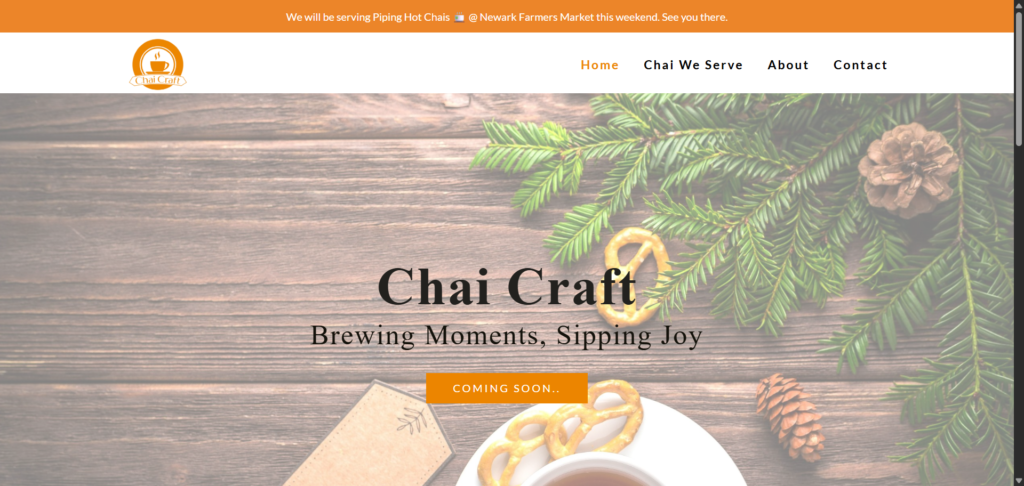
Chai Craft USA is a specialty chai café based in Sunnyvale, California. They serve handcrafted chai, tea, and coffee — the kind of local spot that lives and dies by whether people can find it when they search “chai near me” on their phone.
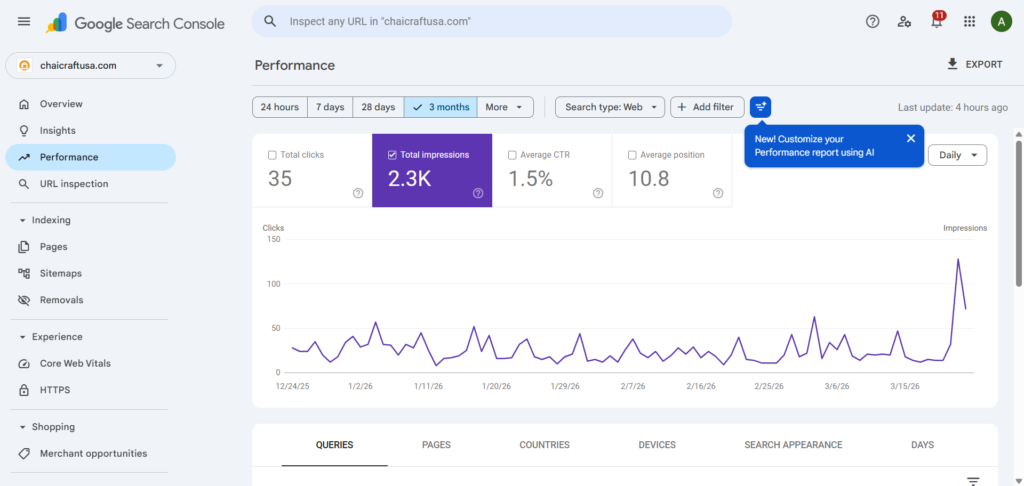
Here’s what their Google Search Console data looks like over their first three months online (December 2025 to March 2026):
- ~2,300 impressions — Google is surfacing the site in local searches
- 35 clicks — real people finding and visiting the site
- Average position: ~8–10 — sitting right on the edge of page one
- Mobile accounts for the majority of traffic — 20 mobile clicks vs 15 desktop, which makes sense for a local café
The most important number in that data?
“Chai near me” is generating 346 impressions at an average position of 9.2.
That means Google is already showing Chai Craft’s listing to hundreds of people every month searching for exactly what they offer — but the site is sitting just outside the top results where the clicks actually happen.
Position 9 sounds close to page one.
In practice, positions 1–3 capture the majority of clicks on any search result.
Position 9 gets a fraction of that. The difference between position 9 and position 3 isn’t just a number — it can be the difference between a quiet week and a full house.
That’s the gap this SEO work is designed to close.
The other thing worth noting: the site currently has only four indexed pages — the homepage, a menu page, an about page, and a contact page. That’s a very thin foundation. There’s a lot of room to grow.
Step 1: Get the Technical Foundation Right
Before you write a single word of new content, your website needs to be technically sound.
This is the unglamorous part of SEO, but skipping it means everything else you do is built on sand.
The three things that matter most for a local business site:
Page speed. Google uses page speed as a ranking factor, and slow pages lose visitors before they even read a word. For a mobile-dominant audience like Chai Craft’s, this is especially important — people searching “chai near me” on their phone are not going to wait four seconds for a page to load. Run your site through Google’s PageSpeed Insights and fix whatever it flags.
Mobile-friendliness. Chai Craft’s data tells the story clearly: most of their visitors are on mobile. If your site is hard to use on a phone, you’re losing people before they’ve even seen your menu or your address. Google knows this too.
Indexability. Google can only rank pages it can find and crawl. Set up Google Search Console (it’s free) and check that your important pages are being indexed. This is also where you’ll submit your sitemap and monitor for errors.
Once those are handled, check your metadata. Every page on your site should have a clear, unique title tag and meta description — these are what people see in search results before they decide to click. Use this free meta tag analyser to check yours in seconds.
And if you’re sharing your pages on social media or Google Business Profile, make sure your Open Graph tags are set up correctly — they control how your pages look when shared. You can preview your Open Graph tags here before anything goes live.
For a full review of your site’s health, work through this website audit checklist — it covers everything from crawlability to Core Web Vitals in plain language.
Step 2: Find Keywords You Can Actually Rank For
This is where most small businesses make their first big mistake: they either ignore keywords entirely and hope for the best, or they go after terms that are far too competitive.
For a local business like Chai Craft, the keyword opportunity is right there in the data. “Chai near me” gets 346 impressions a month and the site is already at position 9. That’s not a keyword to chase from scratch — it’s a keyword to push from 9 to 3. And there are more like it: “chai place near me,” “chai cafe sunnyvale,” “best chai near me” — all showing up, all within reach.
The principle applies to any local business: focus on hyper-local, intent-driven searches first. Someone searching “chai sunnyvale” or “chai near me” is not doing research — they’re about to go somewhere. That’s the person you want to rank for.
How to find these keywords without spending a fortune:
- Google Search Console (free): shows you what queries your site is already appearing for, even when you’re not getting clicks yet. For Chai Craft, this is the first place to look — the data is already there.
- Google’s autocomplete and “People Also Ask”: type your main service into Google and pay attention to what it suggests. “Chai near me,” “best chai near me,” “authentic chai near me” — these are all showing up for Chai Craft already.
- Paid tools: if you want more depth, the Semrush alternatives guide is a good starting point if you’re on a tight budget and want to compare tools before committing.
Once you’ve got your keywords, track them. You need to know whether your rankings are moving week by week, or standing still. A solid SEO reporting tool makes that easy to monitor without having to check Search Console manually every day.
Step 3: On-Page SEO — The Stuff That Actually Moves Rankings
You’ve identified your keywords. Now you need to make sure your pages are sending clear signals to Google about what they’re about.
This isn’t about cramming a keyword into every sentence. It’s about clarity — making it unmistakable to Google what each page covers, and making it genuinely useful to the person who lands on it.
The essentials:
Title tag. Every page needs one. It should include your primary keyword and read like something a human would actually want to click. “Chai Craft USA — Authentic Handcrafted Chai in Sunnyvale, CA” is better than just “Home.”
H1 and subheadings. Your H1 should match or closely reflect your title tag. Use H2s to structure the page. For a menu page, that might mean headings for different drink categories. For a local business homepage, it might mean clear sections for what you offer, where you are, and how to find you.
Your address and hours — everywhere. For local SEO, your NAP (Name, Address, Phone) needs to be consistent across your website, your Google Business Profile, and any other directory listing. Chai Craft’s contact page should have this, and so should the footer of every page.
Internal links. If your homepage mentions your menu, link to it. If your about page talks about the café space, link to your contact page with the address. Four pages isn’t many, but they should all be connected.
Image alt text. A photo of your chai without alt text is invisible to Google. Describe it: “handcrafted masala chai at Chai Craft USA Sunnyvale.”
A few Chrome extensions for digital marketing can surface on-page issues as you browse your own site without needing to run a full audit every time. And if you’re planning to add a blog or more content pages, AI writing tools can speed up drafting — though the local knowledge and personality still need to be yours.
Step 4: Content That Earns Rankings
Right now, Chai Craft’s website has four pages. That’s a start, but it’s not enough to capture the full range of searches that potential customers are making.
Think about what someone searches before visiting a new café:
- “best chai near me”
- “authentic Indian chai Bay Area”
- “what is masala chai”
- “chai vs coffee caffeine”
- “chai sunnyvale open now”
The site currently has no content targeting most of those. Adding it doesn’t mean writing a dozen blog posts overnight — it means being strategic about which pages would do the most work.
This is called matching search intent — understanding what someone actually wants when they type a query, and giving them exactly that.
For a local café, the most valuable content additions are usually:
A dedicated location page that explicitly names the city, neighbourhood, and nearby landmarks. “Chai Craft USA — Sunnyvale’s home for handcrafted chai, just off Murphy Avenue” gives Google something to anchor on.
An expanded menu page that names every drink, includes descriptions, and naturally incorporates the search terms people use (“masala chai,” “cutting chai,” “iced chai”). This is also what shows up in Google’s featured snippets and AI Overviews.
An FAQ section answering the questions people actually ask: Is the chai dairy-free? Do you serve food? Where’s the nearest parking? These questions appear in “People Also Ask” and are easy wins for local visibility.
The point isn’t to become a content publisher. It’s to have enough pages to cover the searches your customers are already making — and right now, Chai Craft has significant room to grow there.
Step 5: Building Authority (Without a PR Budget)
Here’s the uncomfortable truth about SEO: two websites with identical content won’t rank equally if one has credible sites linking to it and the other has none.
Backlinks — links from other websites pointing to yours — are one of Google’s strongest trust signals. For a local business, this plays out differently than for a national brand. And for Chai Craft, one channel is already doing the heavy lifting before any serious link building has even started.
Google Business Profile: The Unsung Workhorse
Look at Chai Craft’s Google Business Profile data from October 2025 to March 2026:
| Metric | Total (6 months) |
|---|---|
| Total Business Profile interactions | 392 |
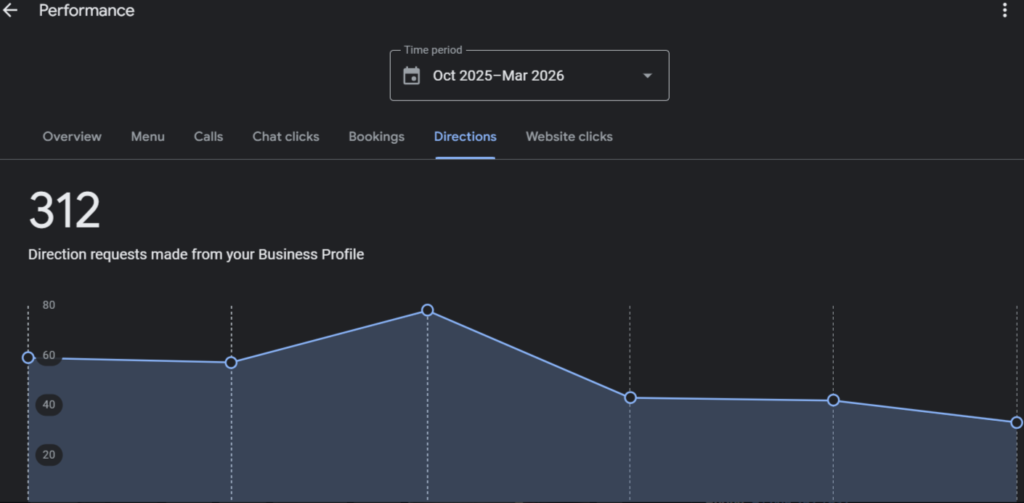
| Direction requests | 312 |
| Website clicks from GBP | 61 |
| Calls from GBP | 7 |
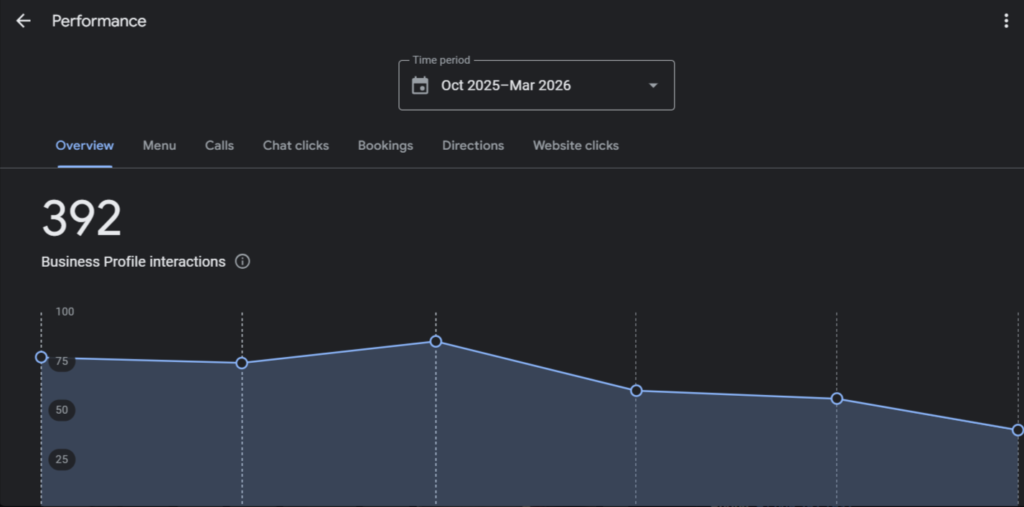
Let that sink in for a moment. The website itself generated 35 organic clicks in three months. The Google Business Profile generated 61 website clicks in six months — nearly double — plus 312 people actively requesting directions to the café. That’s 312 people who found Chai Craft on Google Maps and decided to go there.
The website is important. But for a physical local business, the Google Business Profile is often the most direct line between a search and a visit. It works independently of the website, it shows up above organic results in local searches, and it converts at a much higher rate because the intent is so immediate — someone searching “chai near me” and tapping “Directions” is already sold.
What makes a Business Profile perform well:
- Complete information: hours, address, phone, website, category, attributes (dine-in, takeaway, etc.)
- Photos: businesses with photos get significantly more direction requests and clicks than those without. Recent, high-quality photos of your drinks, space, and signage matter.
- Regular posts: Google Posts (short updates, offers, events) keep the profile fresh and signal to Google that the business is active.
- Q&A: proactively answer the questions customers ask — parking, dietary options, payment methods.
- Review responses: replying to every review (positive and negative) shows Google and potential customers that the business is engaged.
The direction request trend in Chai Craft’s data is particularly telling — it peaked around December/January and has been gradually declining since. That’s worth paying attention to. It could reflect seasonal patterns, or it could mean competitors are creeping up in local rankings. Either way, it’s a metric worth tracking monthly alongside your Search Console data.
Local Directory Listings
Beyond Google, consistent listings across Yelp, TripAdvisor, Foursquare, and local business directories build what’s called citation authority — Google cross-references these listings to verify that a business is legitimate and located where it says it is. The NAP (Name, Address, Phone) needs to match exactly across all of them. Even small inconsistencies — “St.” vs “Street,” or a slightly different phone number format — can dilute the signal.
Press and Local Media
A feature in a Sunnyvale community blog, a mention in a Bay Area food newsletter, a write-up in a local paper — these generate backlinks with real authority behind them. The guide to PR and media outreach for SEO covers exactly how to approach this even with no PR budget.
Review Generation
Google reviews are a local ranking factor — not just social proof. A business with 200 reviews and a 4.7 average ranks higher than one with 12 reviews and a 4.9. For a café with daily foot traffic, a simple “if you enjoyed your chai, we’d love a Google review” at the point of purchase is one of the highest-ROI SEO actions available. It’s free, it builds trust, and it compounds month after month.
How Long Does SEO Actually Take?
Here’s the honest answer: longer than most people expect, and shorter than most people fear.
For a local business like Chai Craft, the timeline moves faster than for a national website — because you’re competing in a smaller pool. “Chai near me in Sunnyvale” has far fewer competitors than “best chai brand in the US.”
A rough timeline for a local business starting from scratch:
Month 1–2: Technical fixes, Google Business Profile set up, basic on-page SEO done. You start appearing in search results. Impressions grow. Clicks are still low.
Month 3–4: Position improvements on key local terms. “Chai near me” moves from position 9 toward position 5. Meaningful clicks start coming in. Review count grows.
Month 5–6: With location content and local citations in place, you start appearing in the local map pack for your main terms. This is where foot traffic noticeably increases.
Month 9–12: Compounding. Pages that have been earning clicks and reviews maintain their rankings without as much active work. New content ranks faster because your domain has more authority.
Chai Craft’s data shows exactly where they are in this journey — early phase two, on the edge of positions where clicks start happening consistently. The impressions are there. The next few months are about converting that visibility into actual visits.
How much you invest shapes the speed of that journey. If you want to think through what SEO investment makes sense for your business, this breakdown of SEO budget allocation is a useful starting point.
Mistakes That Slow Everything Down
A few things I see small businesses do that add months to the process:
Treating the website as a one-time project. A website isn’t a brochure you print and file away. Google rewards sites that are actively maintained, updated, and expanded. Chai Craft adding two well-optimised pages would have more impact than most technical tweaks.
Ignoring Google Business Profile. For a local café, Google Maps is often more important than the website. If the Business Profile has incomplete hours, no photos, or inconsistent information, you’re leaving your highest-converting local channel half-finished.
Expecting results in six weeks. The businesses that win at SEO are the ones that treat it as a channel they’re building, not a button they’re pressing. If you’re putting in consistent work and tracking the right metrics, you’ll see progress — just not immediately.
Not asking for reviews. A physical café has something most websites don’t — daily face-to-face interactions with happy customers. That moment at the counter is a link-building opportunity most small businesses never use.
For more on building a sustainable local presence, the local online marketing strategy guide covers the practical side of combining SEO with the other channels that matter for local businesses.
Where Chai Craft USA Goes From Here
Right now, the site has:
- A strong foothold in local search — appearing for “chai near me,” “chai sunnyvale,” and related terms
- An average position of ~8–10 — one meaningful push from regular page-one clicks
- Only four indexed pages — significant room to expand content and coverage
- Mobile-dominant traffic — which matches exactly how local café discovery works
The next phase is straightforward: push “chai near me” from position 9 into the top 5, add content that covers the adjacent searches people are making, and build the review count and local citations that will solidify those rankings long-term.
None of that requires a big budget or a team of specialists. It requires knowing what to do, doing it consistently, and measuring whether it’s working.
The Short Version
Here’s the five-step process, without all the detail:
- Fix the technical foundation — speed, mobile, indexability, metadata
- Find keywords you can rank for — local, specific, high intent
- Optimise your pages — title tags, structure, NAP consistency, internal links
- Create content that matches what people are searching — location pages, menus, FAQs
- Build authority over time — Google Business Profile, local directories, reviews, PR outreach
SEO isn’t a shortcut. But for a local business with a good product and a half-built web presence, the gap between where you are and where you could be is smaller than it looks.
If you’d rather have an expert team handle this for you, get a free SEO audit from Visibility Ventures. If you’re based in New York and evaluating your agency options first, our roundup of the best digital marketing agencies in New York is a useful place to start.