

Want to rank higher on search engines? Focus on topical authority.
Topical authority is about proving you’re the expert on a specific subject. Instead of creating one-off articles, you build a network of in-depth, interconnected content that search engines trust to answer user queries comprehensively.
Here’s the process in a nutshell:
- Choose a niche topic where you can stand out.
- Create pillar content (3,000–5,000 words) to cover the main topic broadly.
- Add supporting cluster pages (1,500–2,500 words each) to dive into subtopics.
- Use internal linking to connect all related content, signaling expertise.
- Fill content gaps by researching what competitors cover and what your site misses.
This approach not only boosts rankings but also helps you rank for long-tail keywords, increases traffic, and builds trust with search engines. By 2026, search engines and AI tools prioritize depth, semantic connections, and user intent over traditional keyword tactics.
If you’re serious about dominating your niche, focus on building topical authority step by step.
What this article covers:
- Why topical authority is key to ranking in 2026
- How to structure pillar and cluster content
- Tools like SEMrush and Ahrefs for content gap analysis
- Practical tips for internal linking and content maintenance
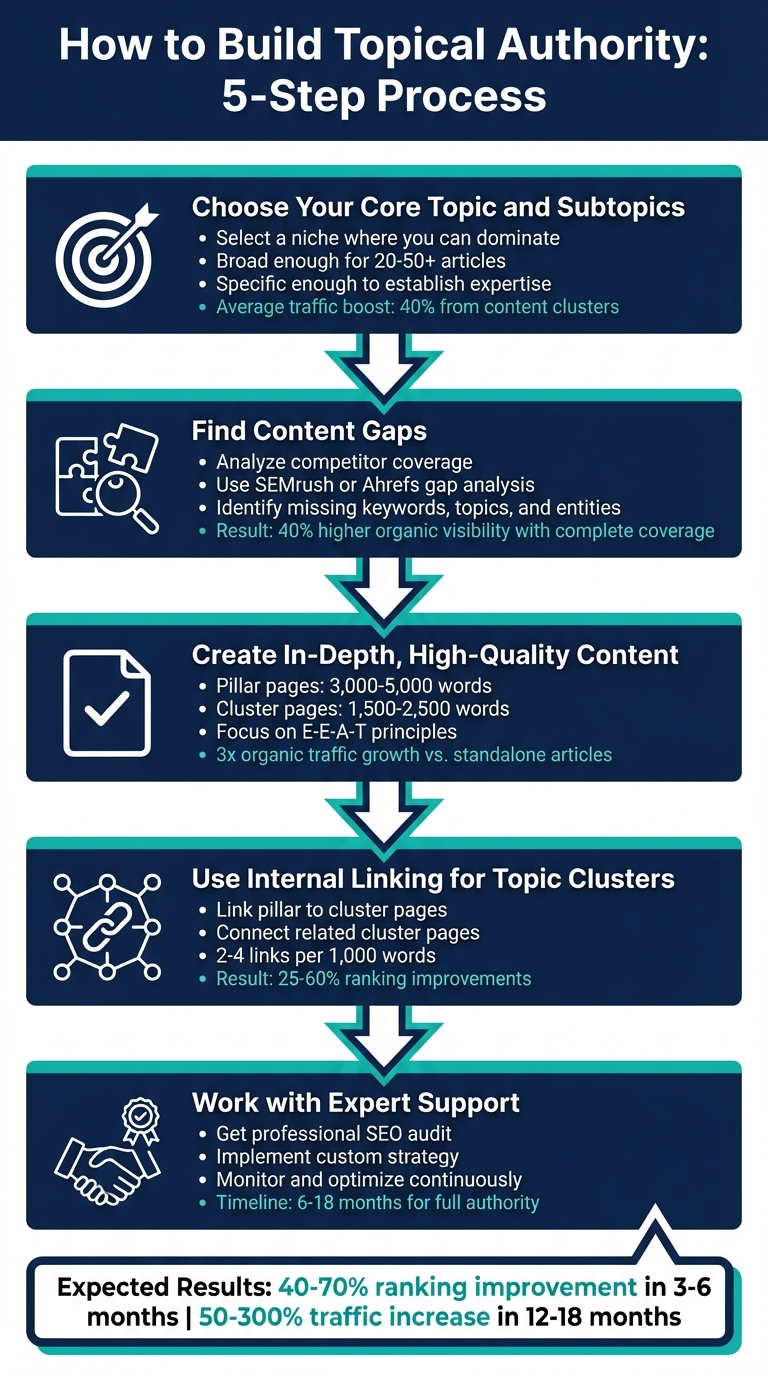
5-Step Process to Build Topical Authority and Rank Higher
How to Build Topical Authority in 2026 (Step-by-Step)
Why Topical Authority Improves Search Rankings
Topical authority plays a key role in establishing your site as an expert in its field, and its influence on rankings is both measurable and impactful. When search engines recognize your site as a trusted source on a subject, they reward it with higher rankings. Modern algorithms now prioritize in-depth topic coverage and semantic understanding over traditional keyword matching.
The numbers back this up. A study analyzing 250,000 search results revealed that comprehensive topic coverage is a stronger predictor of top rankings than keyword density. For sites using a pillar-and-cluster content model, rankings can improve by 40–70% within 3 to 6 months. Businesses adopting this strategy often see traffic increases ranging from 50–300% over 12 to 18 months.
Another major benefit of topical authority is the ability to rank for long-tail keywords – those related search queries you didn’t explicitly target. By month nine, a site with strong topical authority can grow from ranking for 5 keywords to 47 related terms, according to projections for 2026. This happens because search engines trust that if you’ve thoroughly covered one aspect of a topic, you’re likely to provide reliable answers to related queries as well.
Topical authority also leads to faster indexing and more stable rankings. New content on sites with strong authority gets indexed quickly because it fits into an established framework that search engines already understand. Additionally, rankings for such sites are less affected by minor algorithm changes since their authority is grounded in comprehensive expertise rather than isolated tactics.
These insights highlight how focusing on topical authority can benefit businesses, especially those following the strategies outlined in this article.
Topical Authority vs. Domain Authority: What’s the Difference?
It’s essential to distinguish between topical authority and domain authority to understand why in-depth content matters more than traditional ranking signals. While often confused, these two concepts operate very differently. Domain Authority (DA), a metric from tools like Moz or Ahrefs, predicts your site’s ranking potential based on factors like backlinks and site age. Topical Authority (TA), however, reflects how search engines assess your expertise on specific subjects through content depth and semantic connections.
Here’s a comparison to break it down:
| Factor | Domain Authority (DA) | Topical Authority (TA) |
|---|---|---|
| Primary Driver | Backlink profile (quality/quantity) | Content depth and semantic coverage |
| Measurement | Third-party tools (1–100 scale) | Search engine evaluation (NLP/Entities) |
| Timeline | Long-term (12–24+ months) | Short-to-medium term (3–6 months) |
| Scope | Site-wide strength | Specific topic or niche expertise |
| Control | Limited (depends on external sites) | High (depends on internal content) |
| Google’s Use | Not a direct ranking factor | Directly influences rankings via E‑E‑A‑T |
The difference also impacts your budget. Increasing a site’s DA from 40 to 50 can take 12–24 months and cost between $500 and $2,000 per DA point in competitive industries. In contrast, building a complete topic cluster – one pillar article with 5–10 supporting pieces – costs $1,000 to $3,000 and can yield results in just 3–6 months. As Goran Mirkovic, Head of Content at Multiplier, puts it:
Topical authority isn’t a growth hack. It’s building compounding interest. The more clearly and completely you cover a topic, the more visible and credible you become.
This explains why smaller sites with low DA often outrank larger competitors – they provide deeper, more relevant answers to niche queries. In fact, sites prioritizing topical authority can achieve ranking improvements up to 3× faster than those focusing on domain authority alone.
Step 1: Choose Your Core Topic and Subtopics
The first step in building authority in your niche is selecting a core topic that aligns with your expertise, market demand, and the products or services you offer. This isn’t about chasing high-volume keywords – it’s about finding a subject where you can genuinely establish yourself as the go-to expert.
Your chosen topic should strike a balance: broad enough to support 20–50+ interconnected articles but specific enough for you to dominate as a niche authority. For instance, instead of targeting "watches", a small business might focus on "smartwatches for runners." This narrower focus allows for in-depth coverage while still offering plenty of content opportunities.
Before creating content, take a moment to understand your Ideal Customer Profile (ICP) and their key pain points. This ensures your content addresses real challenges instead of just chasing search volumes. Tools like Google Auto Complete, "People Also Ask" boxes, and "Related Searches" can help you uncover the questions and subtopics your audience cares about most.
Once you’ve nailed down your core topic, break it into subtopics by mapping out key entities and their relationships. This ensures you cover all relevant angles before you start writing. Tools like Semrush’s Personal Keyword Difficulty (PKD) can help you prioritize subtopics by analyzing your current topical footprint.
When done right, content clusters can boost organic traffic by an average of 40%. Keep in mind that building authority takes time – typically 6–18 months of consistent effort. To refine your subtopic strategy, SEO tools are invaluable.
Using SEO Tools to Find Topics
With your core topic in hand, SEO tools can help you refine your approach to subtopics. These tools turn guesswork into data-driven insights. Start by using platforms like Semrush or Ahrefs for keyword research. In Semrush, the Keyword Magic Tool is particularly useful – enter your main term and filter results by questions, related keywords, or search intent. This helps you identify the specific queries users are asking and the related terms search engines associate with your topic.
Ahrefs offers a feature called Topic Share, which measures how much of the search traffic for a given topic you’re capturing. You can also use competitor gap analysis to find opportunities. Export the top-ranking pages for your core term, review their content structure, and identify subtopics they’ve only touched on lightly or missed altogether. These gaps often present high-value opportunities for your content.
Classify your subtopics by search intent – whether they’re informational (learning), commercial (comparing), navigational (finding), or transactional (buying). This ensures your content addresses every stage of the customer journey. The goal isn’t just to rank for keywords; it’s to cover the entire knowledge landscape within your niche. As Hans van Gent, Founder of User Growth, puts it:
Topical authority isn’t a trick or a score you can game. It’s the result of covering a subject end-to-end with helpful content, clean architecture, and proof that it drives revenue.
Creating a Topic Cluster Map
A topic cluster map acts as your blueprint for organizing subtopics into a logical, interconnected framework. At the center is your pillar page – a comprehensive, 3,000–5,000-word overview of your core topic. This page links to multiple cluster pages, which in turn explore specific aspects in detail (typically 1,500–2,500 words each). Together, these pages create a web of content that signals expertise to both users and search engines.
To get started, create your pillar page to broadly cover your core topic without diving too deeply into individual subtopics. Next, identify 10–20 cluster pages that tackle specific subtopics in greater depth. Each cluster page should focus on a distinct keyword or search intent to avoid overlap.
Visualize your cluster map using a spreadsheet or diagram. Place the pillar page at the center, with cluster pages branching out. Use bidirectional linking: every cluster page should link back to the pillar with keyword-rich anchor text (not generic phrases like "click here"), and the pillar should link out to all cluster pages. This structure helps search engines understand the relationships between your content and strengthens your topical authority.
Set clear word count goals for each content layer to ensure depth without unnecessary fluff:
| Content Layer | Word Count Goal | Purpose |
|---|---|---|
| Pillar Content | 3,000–7,000 | Broad overview of the main topic |
| Cluster Hubs | 2,000–4,000 | Detailed guides on major sub-themes |
| Supporting Articles | 1,000–2,500 | In-depth coverage of specific long-tail topics |
This structured approach creates a cohesive content ecosystem where every piece plays a role in building your authority. As Brandon, an SEO Strategist at ClickRank, explains:
In 2026, search engines and AI tools reward websites that cover a topic deeply, connect related content clearly, and consistently solve user problems.
Step 2: Find Content Gaps
Once you’ve mapped your topic clusters, the next step is to identify the subtopics you’re missing that competitors have already covered. This is where content gap analysis becomes invaluable. By pinpointing areas where your site lacks coverage, you can uncover opportunities with strong potential. This process not only helps you see the complete topic landscape but also ensures you’re not leaving any gaps in your strategy.
Content gap analysis involves comparing your domain with competitors to identify keyword, topic, and entity gaps – essentially, the search terms, broader subjects, and concepts that search engines expect to see in well-rounded content. Modern tools now also highlight AI visibility gaps, which show where competitors are appearing in AI-generated summaries or chatbot responses while your brand is absent. Considering that 26% of searchers stop their session after reading an AI-generated summary, being present in these results is becoming increasingly important.
Websites that achieve complete topic coverage tend to see 40% higher organic visibility compared to those with fragmented approaches. The key lies in using the right tools to systematically identify these gaps and then turning them into an actionable content plan.
Using SEMrush or Ahrefs for Gap Analysis
To uncover these gaps, tools like SEMrush and Ahrefs are your go-to options. Both platforms excel in identifying opportunities, though they take slightly different approaches.
- SEMrush: Start with the Keyword Gap tool. Enter your site and up to four competitors, then filter by "Missing" to find keywords all competitors rank for but you don’t. Alternatively, use "Underutilized" to discover terms where at least one competitor ranks but you haven’t gained traction. Apply a Keyword Difficulty (KD) filter – typically in the 0-49 range – to focus on terms that are easier to rank for. SEMrush also offers the Topic Research tool, which takes a broader approach. Enter a competitor’s domain, and the tool presents topics as cards. Green cards highlight areas they cover well, while gray cards reveal subtopics they haven’t addressed. This visual approach helps you think beyond individual keywords and focus on broader subject areas.
- Ahrefs: Use the Site Explorer > Content Gap feature. Enter competitor domains and exclude your own to reveal keywords your competitors rank for that you’re missing. Filter these results by keywords with a difficulty score lower than your domain’s Domain Rating (DR) to target terms you can realistically compete for. To avoid thin content, check the "Parent Topic" column, which groups related keywords into broader themes.
Regardless of the tool, always validate gaps manually by reviewing search results. If the top results for a keyword are calculators or tools, but you’re planning a blog post, the search intent may not align with your format. As Ajdin Perco, Director of Content at Organic Growth Marketing, puts it:
We build an LLM matrix that contains prompts prioritized by features and solutions highly important to our clients. And we then analyze LLM visibility gaps for these prompts.
Organizing Gaps for Content Planning
Once you’ve identified your gaps, it’s time to organize them into a structured content plan. A simple spreadsheet works well, with columns for Subtopic/Keyword, Search Volume, Keyword Difficulty, Search Intent (Informational, Commercial, or Transactional), and Coverage Status (Missing, Weak, or Needs Refresh).
To prioritize, categorize gaps into a matrix:
- High Impact/Low Effort: Quick wins like refreshing outdated content or adding FAQs.
- High Impact/High Effort: Larger projects, such as creating comprehensive pillar pages on competitive topics.
- Low Impact: These can often be ignored.
For a more advanced approach, calculate an Opportunity Score using this formula: (1 / Keyword Difficulty) × Traffic Potential × (CPC + 1). This helps you weigh ranking difficulty against traffic and potential revenue.
Finally, group related gaps into topic clusters rather than treating them as standalone keywords. For example, if you find 15 missing keywords related to "smartwatch battery life", create one comprehensive cluster page instead of 15 separate articles. This strategy strengthens your topical authority and avoids content cannibalization. Alex, an SEO Strategist at TopicalHQ, sums it up well:
If an entity appears in the top 3 ranking pages for a core term, it is a required component of your content architecture.
Step 3: Create In-Depth, High-Quality Content
Once you’ve pinpointed the gaps in your content, the next move is to craft detailed, high-quality material that fully explores your topic. This isn’t about flooding your site with shallow, keyword-stuffed articles. Instead, it’s about creating resources that thoroughly address your audience’s questions. Google’s 2026 guidelines emphasize this: unique, well-researched content wins over sheer quantity. By addressing the gaps you’ve identified, you can position yourself as an authority in your field.
Search engines today prioritize content that demonstrates a deep understanding of a subject, favoring semantic, entity-based content over isolated keywords. The results back this up – sites using content clusters report three times the organic traffic growth compared to those relying on standalone articles. On top of that, clustered content tends to drive 30% more organic traffic and maintains rankings 2.5 times longer.
To stand out, focus on offering original insights. This could mean conducting your own research, sharing first-hand experiences, interviewing experts, or presenting unique data. Your content should also align with E-E-A-T principles – Experience, Expertise, Authoritativeness, and Trustworthiness. Including detailed author bios and citing credible sources is no longer optional; it’s a must to differentiate your work from generic, AI-generated material.
Developing Pillar Pages and Cluster Content
Using your gap analysis as a foundation, the hub-and-spoke model is an excellent way to organize content for maximum impact. At the center is your pillar page, which serves as the definitive resource on a broad topic. Supporting this are cluster pages, which dive deeper into specific subtopics. Think of the pillar page as the "home base" that readers can return to, while cluster pages act as the detailed guides for niche questions.
Pillar pages should typically range from 3,000 to 5,000 words, or even longer for complex subjects. These pages should introduce key concepts, address broad user intent, and include a table of contents to guide readers to related content. Link your pillar page to each cluster page, creating a clear navigation structure that signals comprehensive topic coverage to search engines.
Cluster pages, on the other hand, focus on specific long-tail questions or intents. These pages, usually between 1,500 and 2,500 words, target one specific topic at a time. Avoid mixing multiple intents on a single page, as this can dilute rankings. Use descriptive, keyword-rich anchor text to link these pages back to the pillar – steer clear of generic phrases like "click here."
This strategy delivers results. For example, the UK e-commerce retailer Land of Rugs transitioned from product-focused pages to topic clusters using Keyword Insights. By mid-2022, they saw a 119% increase in blog page views compared to the prior year. This shift also generated over $100,000 in revenue.
Here’s a helpful breakdown for planning your content:
| Content Type | Target Intent | Recommended Word Count | Role in Cluster |
|---|---|---|---|
| Pillar Page | Broad Informational | 3,000–5,000+ | Central Hub / Navigator |
| How-To Guide | Actionable/Informational | 1,800–2,500 | Supporting Spoke |
| Comparison | Commercial/Decision | 2,000–3,000 | Supporting Spoke |
| FAQ/Deep-Dive | Specific Question | 1,200–1,800 | Supporting Spoke |
| Case Study | Trust/Proof | 1,500–2,500 | Supporting Spoke |
This structure not only improves navigation but also solidifies your authority on the topic across your site.
Don’t Ignore Technical Details
Technical optimization plays a big role in this strategy. Use schema markup, such as FAQ, HowTo, and Article schemas, on both pillar and cluster pages. This helps search engines – and increasingly, AI tools – understand and prioritize your content. As Generative Engine Optimization (GEO) becomes more important, these technical signals help ensure your content is the go-to source for AI-generated answers.
Content maintenance is just as critical. Schedule quarterly updates to merge overlapping material, refresh outdated stats, and fix orphan pages (those without internal links). Regular updates not only keep your content relevant but also help maintain your authority and prevent content decay. Staying on top of this ensures you remain the trusted expert in your niche.
Step 4: Use Internal Linking for Topic Clusters
Once you’ve built out your topic clusters, internal linking becomes the glue that holds everything together. It not only helps readers navigate your content but also signals to search engines that your site offers in-depth expertise. Think of it like this: your pillar page serves as the hub, and your cluster pages act as the spokes, all linking back to the hub and to each other. This creates a tightly connected structure that boosts your site’s authority and demonstrates comprehensive coverage of a topic.
Here’s some data to back it up: websites with well-structured content clusters experience three times more organic traffic growth than those with scattered, unlinked articles. In fact, after 12 months, a mature content cluster can lead to a 120% increase in organic traffic compared to its starting point. Yet, despite its importance, 73% of content clusters fail to establish topical authority because internal linking is often overlooked or done haphazardly.
To make your clusters work, link related cluster pages together. This spoke-to-spoke linking strengthens the relationships between your subtopics and keeps visitors engaged longer. Each cluster page should link to 2-3 other related pages within the same topic. For example, if your pillar page is about email marketing, an article on "segmentation strategies" should naturally link to pieces on "automation workflows" and "personalization tactics."
"A small website with two well-structured content clusters will consistently outperform a large site with hundreds of scattered, unlinked articles. The compounding effect of internal links and topical depth is the most underrated ranking factor in SEO today."
- Atilla Kuruk, SEO & AI Search Specialist
Key Tips for Internal Linking
1. Prioritize Contextual Links
Links embedded naturally within your content (contextual links) carry far more weight than those in sidebars or footers. For maximum impact, place internal links – especially those pointing to your pillar page – within the first 2-3 paragraphs of your content. Search engines give extra weight to these early links, so avoid burying them at the bottom.
2. Keep Pages Within Three Clicks
Every page on your site should be reachable within three clicks from your homepage. This improves crawlability and ensures search engines can index your content efficiently. Use tools like Screaming Frog or Ahrefs to find orphan pages – those with no internal links pointing to them. No matter how great the content is, orphan pages are invisible to search engines.
3. Use Descriptive Anchor Text
Anchor text should be clear and relevant, guiding both users and search engines. Mix it up with exact matches ("email segmentation strategies"), partial matches ("how to segment your email list"), and natural phrases ("organize your subscribers into groups"). A varied approach keeps your link profile balanced and avoids over-optimization.
4. Maintain a Balanced Link Density
Don’t overdo it. Aim for 2-4 internal links per 1,000 words of content. Also, keep your total internal links per page under 150, including navigation links, to avoid diluting your authority. A well-implemented internal linking strategy can lead to 25-60% ranking improvements and up to 80% growth in organic sessions.
A Practical Internal Linking Structure
Here’s a simple guide to structuring your internal links effectively:
| Link Type | Purpose | Best Practice |
|---|---|---|
| Pillar to Spoke | Distribute authority to subtopics | Add contextual links in relevant sections |
| Spoke to Pillar | Reinforce the hub’s authority | Link back early in the content (first 2-3 paragraphs) |
| Spoke to Spoke | Connect related subtopics | Link between pages with strong semantic ties |
Regular audits are essential. Check for redirect chains, fix orphan pages, and ensure new content integrates smoothly into your clusters. By consistently refining your internal linking, you’ll strengthen your site’s topical authority and improve its overall performance.
Step 5: Work with Visibility Ventures for Expert Support
Once your internal linking and content clusters are in place, the next logical step is to bring in expert guidance to accelerate your efforts. Establishing topical authority isn’t something that happens overnight – it requires precision, strategy, and a deep understanding of how search engines evaluate expertise. While the strategies outlined earlier provide a solid foundation, partnering with experienced SEO specialists can take your efforts to the next level. That’s where Visibility Ventures steps in.
Visibility Ventures complements these strategies seamlessly, ensuring no gaps are left unaddressed. Search engines in 2026 are increasingly favoring "topic experts" over mere "keyword optimizers", focusing on how well content addresses user intent through semantic relevance and entity relationships. Visibility Ventures combines proven SEO tactics with AI-driven insights to uncover and resolve conceptual gaps in your site’s content. Their Free SEO Audit dives deeper than standard keyword checks, employing advanced metrics like the "Salience Score" to evaluate whether your content emphasizes the right entities.
"Topical authority is central to modern SEO as it aligns with how search engines assess expertise and relevance."
- Manick Bhan, Founder CEO/CTO, Search Atlas
Take, for instance, KopyKitab, an EdTech platform that partnered with Visibility Ventures and saw incredible results. In just a few months, they achieved an 11.6x increase in organic traffic, a 142% boost in conversions, 76 keywords landing in top 3 rankings, and a 10% revenue increase. CTO Amit Shrivastava shared:
"Working with Ayush and his team has been a game-changer for our EdTech platform. Within just a few months, Ayush helped us rank for newer keywords, increase ranking for many strategic keywords."
- Amit Shrivastava, CTO, KopyKitab
Why Choose Visibility Ventures?
Visibility Ventures offers a comprehensive, AI-powered audit that evaluates your website, competitors, and industry landscape to uncover specific opportunities for building topical authority. Their Custom SEO Plan is tailored to your business goals and includes:
- On-page SEO consultancy to refine your content and site structure.
- Technical SEO consultancy to improve crawling and indexing.
- Content marketing consultancy to create engaging, search-optimized content.
Their consultant-led approach ensures you work directly with an SEO expert who implements strategies with precision. By leveraging AI insights, they adapt your plan continuously, delivering results like a 45% average increase in organic traffic within 90 days. Their methods are 47% faster and 44% more cost-effective than traditional approaches.
Getting Started with Visibility Ventures
Taking the first step is straightforward. Start with their Free SEO Audit, which provides a detailed 10-page report and competitor analysis to identify gaps in your topical authority. This audit examines the semantic structure of top-ranking competitors, highlights high-salience entities you may be missing, and analyzes "People Also Ask" boxes and Knowledge Panels to uncover key entity associations that Google expects for your topic.
From there, you can opt for a Custom SEO Plan through flexible engagement options like monthly retainers, project-based consulting, or hourly rates. Their team also conducts quarterly competitive entity analyses to ensure your strategy evolves with the changing Knowledge Graph. With 88% of SEO professionals emphasizing the importance of topical authority in their strategies, now is the perfect time to invest in expert support that delivers measurable results.
Conclusion
Building topical authority is a long-term game that pays off exponentially over time. The strategy is straightforward: focus on a niche where your expertise shines, map out all related subtopics and gaps, produce in-depth pillar-and-cluster content, and tie it all together with well-planned internal links. These steps collectively show search engines that your site is a go-to resource for your chosen topic.
Timing is everything. While low-competition topics might show results in 1–3 months, establishing true authority often takes 6–18 months of steady effort. In highly competitive niches, it can stretch to 18–24 months. As Goran Mirkovic, Head of Content at Multiplier, explains:
Topical authority isn’t a growth hack. It’s building compounding interest.
This process builds momentum, ultimately boosting your site’s traffic and visibility.
The numbers back it up: 88% of SEO professionals see topical authority as critical for success, and 61% of B2B marketers say SEO drives more traffic than any other strategy. A standout example is Monday.com, which gained over 630,000 monthly organic visitors by mastering the pillar-cluster approach. Smaller businesses can achieve similar results by focusing deeply within their niche rather than trying to cover too much ground.
Consistency is non-negotiable. Regular audits, content updates, and strategic tweaks are necessary to maintain authority and prevent rankings from slipping. This kind of upkeep requires skill, resources, and a clear strategy – making it worthwhile to collaborate with experts like Visibility Ventures to fast-track your progress. These ongoing efforts reinforce the foundational strategies discussed earlier, ensuring your authority remains strong.
As search engines in 2026 increasingly reward thorough topic coverage, AI-driven tools continue to favor sites that showcase genuine expertise. Whether you’re starting from scratch or scaling up, the strategies outlined here offer a clear path forward. Take the first step with a Free SEO Audit from Visibility Ventures and commit to consistent, strategic work to position your site as the ultimate authority in your niche.
FAQs
How do I pick a niche that’s narrow enough to win but big enough to scale?
When picking a niche, aim for one with a clear and manageable focus. This will make it easier to dive into all the key subtopics without feeling overwhelmed. At the same time, the niche should be broad enough to support consistent content creation and long-term growth.
To find the right spot, try a content gap analysis. This helps you uncover areas where existing coverage is lacking, giving you the chance to stand out. Instead of spreading yourself thin, focus on creating in-depth content that thoroughly answers questions and explores subcategories. This approach not only builds trust with your audience but also signals to search engines that you’re a reliable source. Plus, by keeping some room for future topics, you’ll set yourself up for steady growth.
How many cluster pages do I need before Google treats me as an authority?
When it comes to building authority in Google’s eyes, there’s no magic number of cluster pages you need. That said, a solid starting point is creating a content cluster with 10–20 interconnected pages over a span of 6–12 months. This should include a pillar page packed with 3,000–5,000 words of in-depth content.
The key isn’t just about quantity – it’s about quality. Cover your topic thoroughly, use strategic internal linking to connect related pages, and keep your content fresh with regular updates. These steps can go a long way in earning trust from search engines.
What’s the best internal linking pattern for a pillar-and-cluster setup?
The best internal linking approach for a pillar-and-cluster setup in 2026 is the "inverted authority model." This method focuses on linking from cluster pages back to the pillar page, which strengthens the authority of the pillar content. At the same time, the pillar page links out to the cluster pages, forming a well-organized structure. This setup enhances topical relevance, makes your site easier for search engines to crawl, and helps them grasp the overall structure of your content.