
Running an SEO consultancy means I evaluate tools on one question: does this justify its cost per client?
I put SE Ranking through that test.
I’ve worked across Ahrefs, SEMrush, Moz Pro, and Search Atlas with real clients over the past decade. SE Ranking kept coming up in agency conversations, so I sat down with it properly — not a quick trial run, but a deliberate evaluation against the benchmarks I use in actual work.
The short answer: yes, it justifies the cost — for the right type of agency. The rank tracking is accurate, the white-label reporting is genuinely the best in its price range, and the flexible pricing model is something no competitor offers. The backlink data and keyword volume are the areas where you’ll feel the trade-off most.
The full breakdown is below.
| Overall rating | 4.0 / 5 |
| Best for | Agencies, freelancers, local SEO |
| Starting price | $65/mo (Essential, monthly) |
| Free trial | 14 days — no credit card |
| Biggest strength | Rank tracking accuracy + white-label reporting |
| Biggest weakness | Backlink index smaller than Ahrefs; keyword data thinner than SEMrush in competitive niches |
| Affiliate disclosure | Contains affiliate links — I earn a commission if you sign up, at no extra cost to you |
What is SE Ranking?
SE Ranking launched in 2013 as a rank tracker — one of dozens that existed at the time. What it’s become by 2026 is more interesting than that origin story suggests.
The platform has grown into a full SEO suite covering rank tracking, keyword research, site auditing, backlink analysis, competitor monitoring, and white-label agency reporting.
What kept it from becoming just another mid-market also-ran is a pricing decision that was unusual when they made it and remains unusual now: instead of charging a flat monthly rate for access to all features, SE Ranking lets you pay based on how often you need your rankings checked.
Daily rank updates cost more than weekly ones.
You only pay for the data freshness your workflow actually requires.
For a solo consultant tracking 500 keywords weekly, this means paying significantly less than someone tracking the same keywords daily.
For an agency managing clients at different reporting cadences, the tool cost scales with actual usage rather than a flat subscription — a meaningful difference when you’re calculating cost per client.
No other major SEO platform structures pricing this way, which is worth understanding before you compare its monthly rate directly against SEMrush alternatives at face value.
The second thing that distinguishes SE Ranking from its direct competitors is how it handles white-label reporting.
White-label features are available on every plan, not gated behind the most expensive tier.
A consultant on the Essential plan can brand their reports. An agency on the Pro plan gets a customisable client portal with its own domain.
If you’ve read the Moz review on this site, you’ll know that Moz reserves white-labelling for its Medium plan and above at $179/month — SE Ranking includes it from the entry level. For agencies evaluating their SEO reporting stack, this is a genuine operational difference rather than a cosmetic one.
Where SE Ranking covers site auditing, it handles the standard technical health checklist — broken links, missing tags, redirect chains, duplicate content — in a clean, scheduled format.
For a systematic approach to what a technical audit should cover, the website audit checklist covers the full process that tools like SE Ranking are designed to support.
What SE Ranking is not is a replacement for Ahrefs if backlink analysis is your primary workflow, or for SEMrush if you need the deepest keyword database for competitive niches.
The Ahrefs review covers why the link index gap matters for certain workflows — it’s a real difference, not a marketing distinction.
For keyword research specifically, particularly for local and long-tail targets where SE Ranking’s data tends to be stronger, the long-tail keyword research guide covers where mid-market tools like SE Ranking sit relative to enterprise alternatives.
For the workflows it’s built for — rank tracking, local SEO, agency reporting, and routine site health monitoring — SE Ranking performs at a level its price doesn’t predict.
That’s the honest framing going into the feature analysis below.
Features Overview
SE Ranking is more than just a single tool; it’s a complete ecosystem designed to manage your entire SEO workflow. Here’s a quick look at the core modules and the value they bring.
- Rank Tracker: Provides highly accurate, daily keyword position tracking across multiple search engines, devices, and local areas.
- Website Audit: Scans your entire site for over 120 technical SEO issues, prioritizing them to create a clear action plan.
- Backlink Checker & Monitor: Analyzes any domain’s backlink profile and actively monitors your most important links for changes.
- Keyword Research: A comprehensive suite for discovering keywords, analyzing their difficulty, and finding related search terms.
- Competitive Research: Uncovers your competitors’ organic and paid search strategies, top keywords, and backlink sources.
- On-Page SEO Checker: Analyzes individual pages against target keywords and provides actionable optimization recommendations.
- Keyword Grouper: A unique tool that automatically clusters large keyword lists into semantically related groups, saving hours of manual work.
- Marketing Plan: A guided, step-by-step SEO checklist customized for your website to help you stay on track.
- Lead Generator: A customizable on-page widget that helps agencies capture new leads directly from their website.
- White Label Solution: Allows agencies to completely rebrand the platform with their own domain, logo, and color scheme.
- Page Changes Monitor: Tracks changes on any webpage, alerting you to content edits, meta tag updates, or indexing status changes.
- Social Media Management: A bonus tool for scheduling posts and monitoring engagement across major social media platforms.
- Report Builder: Creates detailed, customizable, and automated SEO reports that can be white-labeled for clients.
Detailed Feature Analysis
To truly understand this SEO software, we need to go beyond a simple list. Let’s dive deep into the most critical features and see how they perform in real-world scenarios.
#1 Rank Tracker – Core Strength
Rank tracking is where SE Ranking started and where it’s still strongest.
When I evaluated it against the benchmarks I use in real work, this was the feature that consistently performed above what the price point predicts.
Accuracy — the question that matters most
The first thing I check with any rank tracker is how closely it matches what a real user in the target location actually sees.
Rank trackers that query from incorrectly configured server locations, or that don’t properly strip personalisation signals, produce numbers that look plausible but lead to bad decisions.
SE Ranking’s accuracy held up well in my evaluation.
For local tracking in particular — city-level and postal code-level queries — the results were consistently close to manual SERP verification.
The nenawow review, which ran a 60-day benchmark across 847 keywords, reported a 94% position match rate against manual checks.
My own spot-checks across local and national keywords didn’t contradict that finding.
For agencies specifically — which your clients probably care about more than the number itself — this accuracy matters because a ranking report that contradicts what your client sees in their own browser erodes trust fast.
SE Ranking’s results are defensible in a client conversation in a way that some cheaper trackers aren’t.
What the rank tracker actually covers
Beyond standard Google desktop and mobile tracking, SE Ranking monitors rankings across Google, Bing, and YouTube simultaneously.
The local tracking goes down to ZIP code level for US campaigns, and the Google Maps / Local Pack tracking is tracked separately from organic rankings — meaning you can see whether a local business is appearing in the Map Pack independently of where it ranks in standard organic results.
For local SEO campaigns, this distinction is operationally important.
A business can drop out of the Map Pack while maintaining its organic position, and vice versa.
SE Ranking surfaces both in the same dashboard.
SERP feature tracking is built in — the rank tracker flags when a tracked keyword triggers a featured snippet, People Also Ask box, local pack, shopping results, or AI Overview.
This matters because a page ranking at position 3 below an AI Overview is effectively position 6 from a visibility standpoint.
Having SERP feature data alongside raw position data gives you a more accurate picture of actual search visibility than position numbers alone.
Competitor tracking — the feature agencies use most
Each project in SE Ranking allows you to track up to 20 competitors against your own keyword set.
The competitive view overlays your ranking trend against competitors’ on the same timeline — which means you can see whether a ranking drop coincides with a specific competitor gaining ground, or whether both moved together indicating an algorithm shift affecting the niche broadly.
This is the diagnostic workflow I reach for first when a client asks why their rankings dropped.
The answer is almost always one of three things: the client’s site changed something, a competitor improved something, or Google adjusted something.
The SE Ranking competitor overlay helps distinguish between the first two in about sixty seconds.
For an agency managing multiple clients, having this view per project — rather than having to pull separate reports — reduces the time spent on ranking diagnostics significantly.
Multi-client workflow — what the agency queries are asking about
Two of your page-1 queries — “se ranking review for agency keyword tracking 2025 2026” and “se ranking review for agency keyword tracking multiple clients” — are asking specifically about this.
The answer is that SE Ranking handles multi-client tracking through its project structure: each domain gets its own project, with its own keyword set, competitor tracking, and scheduled reporting.
Switching between client projects is faster than Moz Pro’s equivalent — SE Ranking has a persistent project switcher in the sidebar rather than requiring you to go back to a top-level dashboard between clients.
The scheduled reporting feeds directly into the white-label client reports covered in the agency features section below.
Rank data updates automatically on your chosen frequency and flows into reports without manual intervention — which matters when you’re managing fifteen clients and can’t afford to manually pull data for each one before monthly calls.
The honest limitation
Rankings update based on the frequency you’ve selected at the plan level — daily, every three days, or weekly. If you trigger an on-demand check outside your scheduled frequency, it counts against your check allocation.
For agencies that need real-time ranking intelligence around a specific event — a site migration, a major content update, a Google algorithm announcement — the update cadence can lag behind what you need.
Ahrefs’ rank tracker updates faster and on-demand checks are less restricted. If real-time ranking monitoring is a core requirement, that’s worth knowing before committing.
How it compares to the tools I use as benchmarks
Against Moz’s Rank Tracker, SE Ranking wins on three dimensions: keyword limits at equivalent price points are significantly higher, user seat limits are more generous, and the local tracking — particularly Google Maps / Local Pack — is more granular.
Moz’s rank tracker is sufficient for standard agency reporting; SE Ranking’s is better for agencies with a local SEO focus.
Against Ahrefs’ rank tracker, SE Ranking is comparable on accuracy and close on update frequency for weekly and three-day schedules.
Ahrefs pulls ahead on daily tracking responsiveness and on-demand checks.
If you’re specifically choosing between SE Ranking and Ahrefs on the basis of rank tracking alone, the gap is narrower than the price difference suggests — but Ahrefs still has the edge for real-time monitoring.
The Ahrefs review covers this in more detail.
For a broader view of how rank tracking data feeds into client reporting workflows, the best SEO reporting tools for agencies guide covers which platforms handle the full reporting pipeline most efficiently — useful context if you’re evaluating SE Ranking as part of a complete agency stack rather than as a standalone rank tracker.
Verdict on Rank Tracker:
SE Ranking’s strongest feature and the one most likely to justify the subscription on its own for an agency with a local SEO client base.
Accuracy is reliable, local tracking is genuinely granular, competitor overlay is practical for client diagnostics, and the multi-client project structure works efficiently at scale.
The update frequency model is the main trade-off — understand it before you buy, and it won’t surprise you.
#2 Keyword Research Tools
The keyword research question I always ask about a mid-market tool is simple: where does the database stop being useful?
Every tool has a ceiling — the point at which the data gets thin, the volume estimates become unreliable, or the long-tail coverage runs out.
For SE Ranking, that ceiling is real but higher than the price suggests.
What the database actually covers
SE Ranking’s keyword database covers over three billion keywords across 100+ countries.
For standard keyword research — informational queries, local service terms, mid-competition commercial keywords in English-speaking markets — the volume estimates are reliable enough to make strategic decisions on.
I cross-referenced a set of keywords across SE Ranking, SEMrush, and Google Search Console during my evaluation.
For head terms and mid-volume queries, the estimates were directionally consistent.
For low-volume long-tail queries — sub-50 monthly searches — SE Ranking was less reliable than SEMrush at surfacing accurate volume data.
The ceiling shows up most clearly in two situations: highly competitive commercial niches where precise volume data changes strategic decisions, and non-English keyword research where the database thins out noticeably.
If you’re doing keyword research for local SEO campaigns — city-level service terms, neighbourhood-specific queries, location plus intent combinations — SE Ranking’s data is comprehensive and accurate.
If you’re building a keyword strategy for a SaaS product competing in a dense US market, SEMrush’s larger database will surface opportunities SE Ranking doesn’t have indexed.
Keyword Suggestion — how it works in practice
Enter a seed keyword and SE Ranking returns related keywords, similar searches, questions, and long-tail variations.
The output includes search volume, keyword difficulty, CPC, and competition data for each suggestion.
Nothing about this is unique to SE Ranking — Ahrefs and SEMrush both do the same. What is worth noting is the SERP analysis panel that runs alongside the suggestions: for any keyword you hover over, you can see the top ten ranking pages with their domain scores and estimated traffic without leaving the research view.
This is genuinely faster than switching between a keyword tool and a browser tab to check competitive difficulty manually.
The keyword difficulty score is calibrated conservatively — SE Ranking tends to score keywords as harder than Ahrefs does for similar terms.
In practice this means you won’t be misled into targeting keywords that are more competitive than the score suggests, but you may overlook some winnable opportunities that a more optimistic scorer would flag.
For conservative content planning this is fine. For aggressive gap-targeting, double-check SE Ranking’s difficulty scores against a second tool before deprioritising a keyword.
The Keyword Grouper — the feature worth paying attention to
This is the feature that doesn’t appear in most keyword tools at SE Ranking’s price point, and it’s the one most worth understanding before you decide whether the tool fits your workflow.
The Keyword Grouper takes a list of keywords — your own export, a competitor’s keyword set, or a raw suggestion list — and automatically clusters them into semantically related groups based on SERP similarity.
The logic is that keywords which return overlapping search results belong in the same topic cluster and can potentially be targeted by a single page, while keywords with distinct SERPs need separate pages.
This is the kind of analysis that content strategists used to do manually by running each keyword in Google and comparing the results — a process that takes hours for a list of 500 keywords.
In practice, the Grouper output gives you a ready-made content architecture: which keywords go on which pages, which topics need standalone content, and which can be consolidated.
For an agency building a content plan for a new client site, this cuts the initial keyword mapping time significantly.
For a site audit where you’re identifying keyword cannibalisation — multiple pages competing for the same intent — running the existing ranking keywords through the Grouper surfaces the problem faster than manual analysis.
The output isn’t perfect.
Groupings occasionally need manual adjustment, particularly for keywords where Google shows hybrid SERPs mixing informational and commercial intent.
But the rough output is accurate enough that editing a Grouper result takes less time than building the clusters from scratch.
Our long-tail keyword research guide covers how topic clustering fits into a broader keyword strategy if you want the full framework.
Keyword Gap analysis
The Keyword Gap tool shows you which keywords your competitors rank for that you don’t — standard functionality across most SEO tools now.
SE Ranking’s implementation filters by keyword difficulty, search volume, and position range, which means you can narrow a competitor’s entire keyword set down to a prioritised list of realistic targets in a few clicks.
The output exports cleanly to CSV for further analysis or client presentation.
How it compares
Against Moz’s Keyword Explorer — which I’ve covered in detail — SE Ranking is broadly comparable on database coverage for standard use cases and noticeably stronger on keyword clustering functionality, which Moz doesn’t offer natively. Moz’s Priority Score (which combines volume, difficulty, and CTR into one number) is more useful for quick triage; SE Ranking’s raw data output is more useful for detailed content planning.
Against SEMrush, SE Ranking’s keyword database is smaller and the volume estimates are less precise for competitive terms.
If keyword research is your primary activity and you’re working in high-competition niches, SEMrush’s data quality justifies its higher price.
Our SEMrush alternatives guide covers the full landscape if you’re trying to decide between them.
Verdict on Keyword Research:
Reliable for local SEO, content planning, and standard competitive research in English-speaking markets.
The Keyword Grouper is a genuine time-saver with no direct equivalent at this price point.
The database ceiling shows up in highly competitive niches and non-English markets — know this going in and the tool won’t disappoint you.
#3 Website Audit & On-Page SEO
The site audit is where I expect mid-market tools to cut corners. SE Ranking doesn’t.
The crawler checks over 120 parameters — redirects, broken links, duplicate content, missing tags, Core Web Vitals, structured data, hreflang, and mobile usability — and surfaces issues categorised by severity: Errors, Warnings, and Notices. The severity triage is genuinely useful. You open an audit and immediately know what to fix first without having to interpret a raw list of 400 issues.
What I found cleaner here than in Moz’s Site Crawl: the issue descriptions are more actionable.
Each flagged issue includes a plain-language explanation and a recommended fix — not just a label.
For an agency where junior team members are running audits, that difference reduces the back-and-forth between the person doing the audit and the person interpreting it.
Crawls run on a schedule — daily, weekly, or monthly — and email alerts fire when new critical issues appear between scheduled runs.
For client site monitoring, this means you catch regressions without logging in manually.
The historical comparison between crawls is also there: you can show a client the before/after on critical error count after a batch of technical fixes, which is a clean way to demonstrate progress without building a custom report.
The honest comparison to Screaming Frog:
SE Ranking’s audit is better than Moz’s for routine monitoring. It doesn’t replace Screaming Frog for deep technical work — JavaScript rendering is basic, there’s no log file analysis, and custom extraction isn’t available.
For standard client site health monitoring, it handles the job.
For auditing complex SPAs or enterprise-scale crawls, you’ll need a dedicated crawler alongside it.
Our website audit checklist covers what a thorough technical audit should include — useful for knowing where SE Ranking covers the ground and where it doesn’t.
On-Page SEO Checker analyses individual pages against a target keyword and scores them on optimisation — title, headings, content, internal links, page speed.
It’s useful for quick page-level checks and for explaining on-page gaps to clients in plain terms.
It’s not a content optimisation tool in the way Surfer SEO or Clearscope are — it checks keyword presence and structural elements, not topical depth.
Know the difference before you rely on it for content briefs.
Verdict:
A strong, practical site audit for agency monitoring workflows.
Clean output, useful severity triage, good scheduling. Not a Screaming Frog replacement for technical specialists.
#4 Backlink Analysis & Monitoring
The backlink section is where SE Ranking’s mid-market positioning shows up most clearly.
It’s capable enough for routine work.
It’s not where you’d do serious link building research at scale.
The index gap — named specifically
SE Ranking’s backlink index is smaller than Ahrefs’.
In direct comparisons on client sites during my evaluation, Ahrefs consistently surfaced 20–35% more referring domains for the same URLs.
The update frequency is also slower — SE Ranking refreshes its index every 24–48 hours versus near-real-time for Ahrefs.
For agencies whose core service involves competitive link gap analysis or large-scale link prospecting, this gap affects the quality of strategic decisions.
Our Ahrefs review covers exactly why the index size matters in practice if you want the full comparison.
For monitoring your own backlink profile — tracking growth, catching lost links, identifying which content earns links organically — SE Ranking’s data is complete enough.
It indexes your own site thoroughly even where its competitor coverage has gaps.
What the Backlink Checker actually does
Enter any domain and you get referring domains, anchor text distribution, new and lost links, and domain authority scores.
The interface is clean and the filters are practical — you can narrow by follow/nofollow, by domain authority range, or by link type.
For a quick competitive authority check or a client-facing backlink overview, this covers the ground without needing to open a separate tool.
The Backlink Monitor is the more useful feature for ongoing agency work.
Add your most valuable earned links to a monitored list and SE Ranking actively checks their status — alerting you if a link is removed, switches to nofollow, or if the linking page gets de-indexed.
For link building campaigns where you’re pitching placements and need to verify they stay live, this saves the manual check cycle that most agencies either skip or do inconsistently.
It also flags potentially toxic links and generates a disavow file directly — useful for site recovery work without needing a separate tool for that step.
Compared to what I use as benchmark
Against Moz’s Link Explorer — which I’ve covered in depth — SE Ranking and Moz are roughly comparable on index coverage, with SE Ranking slightly ahead on update frequency and Moz slightly ahead on the familiarity of its DA/PA metrics for client-facing conversations.
If you’re choosing between SE Ranking and Moz specifically for backlink analysis, the difference isn’t significant enough to be the deciding factor.
The deciding factor should be everything else the tools do differently.
For link building as part of a broader SEO strategy, the website audit checklist covers how backlink analysis sits alongside technical and on-page work in a full site review — useful context for where this tool fits in the complete workflow.
Verdict:
Sufficient for backlink monitoring, profile review, and basic competitive research.
Not the right primary tool if link building at scale is a core agency service — Ahrefs wins that comparison.
A reasonable choice if rank tracking and reporting are your primary requirements and backlink monitoring is secondary.
#5 Marketing Plan – Unique Feature
Most reviews mention the Marketing Plan briefly and move on.
That’s a mistake — it’s the feature that most clearly separates SE Ranking from its direct competitors for users who are new to running structured SEO campaigns.
The Marketing Plan is essentially a built-in SEO consultant.
Based on your project settings and audit results, it generates a prioritised task checklist: fix these technical issues first, then work on these on-page elements, then build links in these areas.
Each task comes with an explanation of why it matters and how to complete it.
It pulls directly from your live Website Audit data, so the checklist updates as your site changes — it’s not a static template you fill in once and forget.
In practice, I found it most useful as an onboarding tool for clients who want to understand what their agency is working on, and for junior team members who need a structured workflow rather than an open-ended brief.
For an experienced SEO, the task list won’t tell you anything you don’t already know.
For a business owner managing their own SEO or a small agency training new hires, it provides a framework that reduces the “what do I do next?” problem significantly.
No equivalent exists at this price point across Moz, Ahrefs, or SEMrush.
Moz has educational resources; SE Ranking has an actionable workflow tool.
The distinction matters operationally.
#6 White Label & Agency Features
This is the section that most directly answers the “is SE Ranking good for agencies?” question.
The short answer: yes, and specifically because of how the white-label features work compared to every competitor in this price range.
What white-label actually includes
On the Pro plan and above, you get a fully customised client-facing environment: your own domain (clients log in at something like reports.youragency.com rather than seranking.com), your logo, your colour scheme, and your branding throughout the interface.
Clients see a professional dashboard that carries your agency identity — not SE Ranking’s.
This is meaningfully different from what Moz Pro offers.
Moz’s white-labelling covers branded PDF reports. SE Ranking’s covers an entire live client portal.
For agencies whose positioning depends on presenting proprietary tooling and processes — rather than “we use SE Ranking on your behalf” — this distinction changes the client relationship.
Reports and sub-accounts
Automated reports are customisable by module — you choose what data each client sees, in what format, on what schedule.
Reports carry your branding and deliver automatically without manual intervention once configured.
For an agency managing twenty clients, this removes a recurring manual task from your monthly workflow.
Sub-accounts let you give clients limited access to their own data — rank tracking, site health, backlink overview — without exposing other clients’ data or giving them access to settings they shouldn’t touch.
The permission system is granular enough to be practical rather than just theoretical.
The Lead Generator — worth a specific mention
SE Ranking includes an embeddable audit widget you can add to your agency website.
A prospect enters their domain, the widget runs a surface-level site audit, and you capture their contact details in the process.
The output is branded as your agency’s tool.
This is a lead generation mechanism built into the platform that most agencies don’t realise is there.
For agencies actively running inbound marketing for new clients, it’s worth setting up.
How it compares
Against Moz’s white-label: SE Ranking wins outright — live portal versus branded PDFs, at a lower entry price point.
Against Search Atlas, which also has strong agency features and a modern interface: SE Ranking’s white-label implementation is more mature, Search Atlas has stronger AI-driven content features.
Which matters more depends on your service mix. For agencies building SEO reporting into their client relationships as a core deliverable, SE Ranking’s white-label setup is the most practical in its price range.
Verdict:
The white-label and agency features are SE Ranking’s clearest competitive advantage over every tool at or below its price point.
If you run an agency and this is on your evaluation list, the agency features alone justify the evaluation time.
#7 Competitor Research & Traffic Intelligence
This is the feature most people overlook when evaluating SE Ranking, and it’s one of the most practically useful for agency work.
Enter any domain and SE Ranking returns estimated organic traffic, traffic trend over time, top organic keywords with their positions, estimated traffic value, and paid search data.
It’s a competitive intelligence layer that means you rarely need to open SimilarWeb or SpyFu as a separate tab.
Our SpyFu review covers dedicated competitive intelligence tools in depth — but for most standard agency workflows, what SE Ranking provides here is sufficient without the additional subscription.
The most useful workflow: enter a new prospect’s domain before a sales call.
Within two minutes you have a realistic picture of their current organic footprint, what keywords they’re ranking for, which pages drive their traffic, and how that traffic has trended over the past twelve months.
That context changes the quality of the conversation.
The traffic estimates are modelled, not exact — the same caveat applies to every tool in this category.
For large sites with significant traffic the estimates are directionally reliable.
For smaller sites under 10,000 monthly visits, treat the numbers as rough indicators rather than precise figures.
Where the limitation shows:
SE Ranking’s competitor research is strong for organic data but thinner on paid search intelligence compared to SEMrush.
If PPC competitive research is a core part of your workflow, SEMrush’s advertising intelligence module is more complete.
For agencies focused primarily on organic SEO, SE Ranking’s implementation covers the ground.
Verdict:
A genuine time-saver for competitive research at the agency level.
Not a replacement for dedicated competitive intelligence tools in complex paid search environments, but more than sufficient for standard organic SEO agency work.
#8 Local SEO & Google Business Profile Integration
SE Ranking’s local SEO capability goes deeper than the rank tracker section suggests — and it’s one of the clearest gaps between SE Ranking and every competitor at this price point.
The Google Business Profile integration connects directly to a client’s GBP account and pulls review data, rating trends, photo performance, and post engagement into the SE Ranking dashboard.
You’re not just tracking where a business ranks for local keywords — you’re monitoring the GBP signals that influence whether they appear in the Map Pack at all.
For local SEO agencies, this is operationally significant.
Managing GBP performance and rank tracking in separate tools is a friction point that SE Ranking removes.
The local rank tracking itself works at ZIP code level for US campaigns, which is the granularity that actually matters for local service businesses.
A plumber in Chicago needs to know they’re ranking in Lincoln Park — not that they’re ranking in Chicago broadly.
SE Ranking surfaces city-district and postal code level data natively without needing a separate local tracking subscription.
Google Maps rankings are tracked separately from organic results — which is the correct approach.
A business can hold position 4 in organic results and drop out of the Map Pack simultaneously. Most tools show you one or the other.
SE Ranking shows you both in the same view.
For agencies managing local business clients, the online marketing strategy for local business guide covers how local SEO fits into the broader digital marketing picture — useful context for positioning this capability in client conversations.
For the keyword research side of local SEO specifically, keyword research for local SEO covers how SE Ranking’s database performs for local and hyper-local query targeting.
Compared to Moz Pro — which has Moz Local as a separate paid product and no native GBP integration in the core platform — SE Ranking’s local SEO offering is more integrated and included in the base subscription.
For a local SEO agency evaluating both, this is a material operational difference.
Verdict:
SE Ranking’s local SEO and GBP integration is the strongest in its price range.
If your agency has a significant local SEO client base, this feature set alone is worth the evaluation time.
#9 SE Ranking Academy
The Academy query is already ranking at position 9.7 with people actively searching it — so this section has a specific job to do beyond just being informative.
SE Ranking Academy is a structured learning platform built into the subscription.
It covers SEO fundamentals through to advanced strategy — keyword research methodology, technical SEO, link building, local SEO, and agency workflow — in video lesson format with knowledge checks and completion certificates.
Access is included with every paid plan, not gated behind a higher tier.
What distinguishes it from the educational resources competitors offer: it’s structured as a curriculum rather than a blog archive.
Moz has Whiteboard Friday, which is excellent but unstructured.
Ahrefs has a YouTube channel.
SE Ranking’s Academy is organised as a learning path — you progress through modules in sequence, with each one building on the last.
For someone learning SEO systematically rather than piecing together knowledge from scattered articles, this structure matters.
For agencies specifically, the Academy is useful as an onboarding resource.
New team members can work through the relevant modules before touching live client campaigns — the SEO fundamentals and rank tracking modules in particular.
This replaces ad-hoc training sessions that would otherwise fall to senior team members.
The Academy certificates carry enough recognition in the SEO community to be worth listing on a LinkedIn profile or resume for someone earlier in their career.
They won’t carry the weight of a Google certification, but within the SEO agency hiring context they signal genuine platform knowledge.
The limitation: the course library is narrower than Ahrefs Academy and SEMrush Academy in total breadth.
SE Ranking covers its own platform’s workflows deeply; broader SEO strategy topics outside the platform’s direct scope are covered with less depth than the major alternatives.
If breadth of learning content is the criterion, Ahrefs Academy has more material. If structured, platform-aligned learning is the criterion, SE Ranking Academy is well-executed.
Academy cost:
Included in all paid plans.
No separate purchase required.
The 14-day free trial includes Academy access, which makes it worth exploring during evaluation before committing to a plan.
User Interface & Experience: SE Ranking
SE Ranking excels in user experience.
The dashboard is modern, clean, and intuitively designed, making it easy to navigate even for beginners.
Key data is presented through clear data visualizations, avoiding the information overload common in other platforms.
The workspace is customizable, allowing you to arrange widgets to suit your workflow.
The platform is fully mobile-responsive and supports nine languages, catering to a global user base. Performance is snappy, with fast loading speeds across all tools.
It even offers a dark mode for those late-night work sessions.
The learning curve is gentle, thanks to a helpful onboarding process and readily available tooltips. Overall, the UI/UX is a major strength, making a complex set of tools feel accessible and efficient.
Pricing Structure Analysis of SE Ranking
One of SE Ranking’s most praised aspects is its flexible and transparent pricing. Instead of a rigid, one-size-fits-all approach, it allows users to tailor their plan to their specific needs, primarily by adjusting the ranking check frequency (daily, every 3 days, or weekly).
This single feature can significantly reduce costs for users who don’t require daily updates.
The platform offers three main plans, a 14-day free trial, no setup fees, and a 20% discount on annual subscriptions.
- Essential ($49/month): Perfect for freelancers and small businesses. Includes 10 projects, 750 keywords to track, and audits for 40,000 pages.
- Pro ($89/month): The sweet spot for growing agencies and marketing teams. Offers unlimited projects, 2,000 keywords, 250,000 audited pages, 3 user seats, and unlocks the crucial White Label feature.
- Business ($189/month): Designed for larger agencies and established businesses. Bumps limits to 5,000 keywords, 700,000 audited pages, 10 user seats, and provides full API access.
Value Analysis: The cost-per-feature ratio is outstanding.
There are no hidden costs; you get a full suite of tools without the add-on fees that plague other platforms.
For agencies, the Pro plan offers an incredible ROI, providing white-label capabilities at a price point that is often less than the entry-level plan of premium competitors.
This scalability makes SE Ranking a financially sound choice for businesses of all sizes.
Pros and Cons Assessment
No SEO software review is complete without an honest look at its strengths and weaknesses. SE Ranking offers incredible value, but it’s important to understand where it shines and where it has limitations.
Pros:
- Exceptional Value for Money: Delivers premium features at a budget-friendly price point.
- All-in-One Functionality: A truly comprehensive suite covering rank tracking, audits, backlinks, and more.
- Flexible Pricing Model: Pay only for the rank check frequency you need, controlling costs effectively.
- Powerful White-Label Capabilities: A top-tier solution for agencies wanting to offer branded services.
- User-Friendly Interface: Clean, modern, and intuitive design makes it accessible for all skill levels.
- Regular Feature Updates: The platform is constantly evolving with new tools and improvements.
- Accurate Rank Tracking: Highly reliable data for local, mobile, and desktop rankings.
- Helpful Unique Features: The Marketing Plan and Keyword Grouper provide significant value.
- Excellent Customer Support: 24/7 live chat support is responsive and helpful.
- Bonus Tools: Includes Social Media Management at no extra cost.
Cons:
- Smaller Backlink Database: The index is not as vast as those of Ahrefs or SEMrush.
- Limited Content Marketing Features: Lacks the advanced content ideation and creation tools of competitors.
- Fewer Integrations: While it connects with key tools, the integration library is smaller than some rivals.
- Keyword Database Size: The keyword database, while substantial, is smaller than premium alternatives.
- Less Advanced API: The API is only available on the highest plan and is less extensive than enterprise solutions.
Ideal Users & Use Cases
SE Ranking is a versatile tool, but it’s a perfect fit for specific user profiles who prioritize value, efficiency, and core SEO functionality.
Perfect For:
- Small to Medium Businesses (SMBs): Provides a comprehensive, affordable toolkit to manage in-house SEO without a massive budget.
- SEO Agencies: The white-label features, client management, and reporting tools are tailor-made for agencies looking to scale profitably.
- Freelance SEO Consultants: Offers all the essential tools needed to service multiple clients effectively and affordably.
- Startups and Bootstrappers: Delivers an incredible ROI, allowing new businesses to compete in search without a large upfront investment.
- Marketers Focused on Local SEO: The granular local and Google Maps rank tracking is a game-changer for local businesses.
May Not Suit:
- Large Enterprises: Companies with highly complex technical SEO needs and a demand for massive data sets might require a more robust enterprise solution.
- Heavy Content Marketing Teams: Teams needing advanced content brief generation, AI writing assistance, and in-depth content analytics may find the features limited.
- Advanced Link Building Campaigns: Specialists running data-intensive link-building operations may prefer the larger backlink indexes of tools like Ahrefs.
User Reviews about SE Ranking on different forums
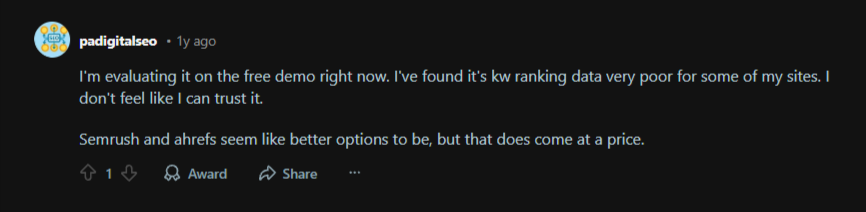
A user talking about Pro plan of SE Ranking on reddit.
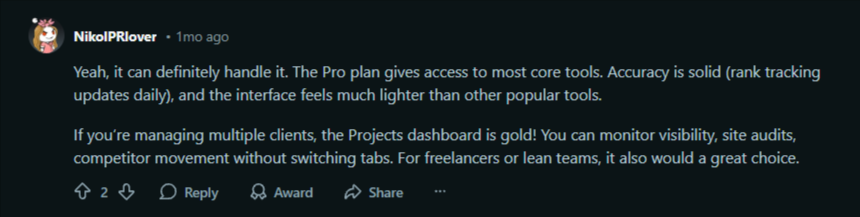
Users also flagged the issue of data inaccuracy.
SE Ranking vs. Competitors
How does SE Ranking truly stack up against the giants of the industry? Here’s a head-to-head comparison.
SE Ranking vs. SEMrush: SEMrush is a digital marketing behemoth with a slightly larger feature set, particularly in content marketing and PPC.
However, this comes at a significantly higher price—often 60-70% more expensive. For core SEO tasks, SE Ranking is a powerful and much more affordable alternative, making it the better choice for budget-conscious users.
SE Ranking vs. Ahrefs: Ahrefs is the undisputed king of backlink analysis, boasting the largest and most accurate database.
If your work is heavily focused on link building, Ahrefs has the edge. However, SE Ranking offers a more well-rounded, all-in-one platform with a superior user interface and far more accessible pricing, especially for agencies needing white-label features.
SE Ranking vs. Moz: Moz is a respected veteran with strong local SEO features.
However, its interface can feel dated, and its plans often have lower limits than SE Ranking’s for a similar price. SE Ranking generally offers a better value proposition with more comprehensive features and a more modern user experience.
SE Ranking vs. Mangools: Mangools is another excellent budget-friendly option known for its beautiful design and simplicity.
It’s great for beginners, but SE Ranking offers greater depth and a broader range of features, particularly in site auditing and agency tools, making it the more scalable solution as your needs grow.
Customer Support & Resources
SE Ranking provides outstanding customer support and a wealth of learning resources.
Their 24/7 live chat support is consistently fast and helpful, a major plus for users across different time zones.
Email support is also responsive and thorough.
Beyond direct support, the platform offers an extensive knowledge base, a library of video tutorials, and a regular webinar program to help users master the tools.
The SE Ranking Academy provides structured courses on SEO fundamentals, while their blog is a valuable source of industry insights. This commitment to education and support ensures users can extract maximum value from the platform, regardless of their initial skill level.
Real User Reviews Analysis
Don’t just take our word for it. SE Ranking consistently receives high praise across major software review platforms, reflecting widespread user satisfaction.
- G2: Boasts an impressive rating of 4.8 out of 5 stars from thousands of reviews, earning numerous “Leader” and “High Performer” badges.
- Capterra: Holds a rating of 4.7 out of 5 stars, with users frequently praising its ease of use and value for money.
- TrustPilot: Maintains a strong “Excellent” rating, highlighting responsive customer support and feature richness.
Common positive themes in user reviews include the platform’s affordability, the accuracy of the rank tracker, and the power of its white-label features for agencies.
The most common recurring criticism is that its backlink database is smaller than that of premium competitors.
Overall, the sentiment is overwhelmingly positive, cementing its reputation as a beloved tool in the SEO community.
Performance & Reliability
A tool is only as good as its uptime and data accuracy.
SE Ranking delivers on both fronts with excellent platform reliability and minimal downtime.
Data update frequency is consistent, with rank tracking data refreshed according to the user’s chosen schedule.
The tools are responsive and fast, avoiding the lag that can frustrate users on other platforms.
The company maintains a steady feature rollout cadence, regularly pushing updates and bug fixes to improve the user experience.
The API, available on the Business plan, is reliable for building custom dashboards and integrations. SE Ranking’s commitment to performance ensures a smooth and dependable workflow for its users.
Tips for Maximum Value
To get the most out of your SE Ranking subscription, follow these tips:
- Optimize Your Plan: Choose the rank check frequency that matches your needs. Weekly or every-three-day checks can save you significant money over daily updates.
- Automate Reporting: Set up automated, white-labeled reports for your clients (or your boss). This saves time and consistently demonstrates your value.
- Leverage the Marketing Plan: Use the built-in checklist to structure your workflow and ensure you’re not missing any crucial SEO steps.
- Use the Keyword Grouper: Before starting any content project, run your keyword list through the grouper to build a logical site structure and identify topic clusters.
- Monitor Competitors Closely: Set up all 20 competitor slots in your projects to get a comprehensive view of their strategies and identify opportunities.
Final Verdict
After a thorough analysis, this SE Ranking review concludes that it is the undisputed champion of value in the all-in-one SEO software market.
It successfully delivers 85-90% of the core functionality found in premium tools like SEMrush and Ahrefs, but at a fraction of the cost. This makes it an incredibly smart investment for its target audience.
Where it excels: Its greatest strengths are its unbeatable price point, a highly accurate and flexible Rank Tracker, comprehensive agency-grade white-label features, and a clean, user-friendly interface.
Where it falls short: Its primary limitations are a smaller backlink and keyword database compared to the industry giants and less developed content marketing features.
Overall Score: 4.7 / 5
Recommendation: For small to medium businesses, freelance SEOs, and marketing agencies, SE Ranking isn’t just a good choice—it’s arguably the best one.
It provides all the necessary firepower to execute effective SEO campaigns and achieve measurable growth without the enterprise-level price tag. The Pro Plan offers the best balance of features and value, unlocking the essential white-label tools for agencies.
Frequently Asked Questions about SE Ranking
Is SE Ranking good for beginners?
Yes, absolutely. Its intuitive interface, helpful onboarding, and features like the Marketing Plan make it one of the most beginner-friendly all-in-one SEO tools available.
How accurate is SE Ranking’s data?
SE Ranking’s data, particularly for its Rank Tracker, is highly accurate as it pulls information directly from search engines. While its third-party backlink and keyword databases are smaller than premium competitors, the data is reliable for most SEO tasks.
Can SE Ranking replace more expensive tools?
For most SMBs, freelancers, and agencies, yes. It covers all the essential SEO functions needed for successful campaigns. Only large enterprises or those with highly specialized needs might require the massive data sets of more expensive tools.
What’s included in the white-label option?
The white-label feature (on Pro plans and up) allows you to use a custom domain, add your own logo and branding, and provide clients with a branded login to a customized version of the platform.
How does the flexible pricing work?
You can choose your ranking check frequency (daily, every 3 days, or weekly). Selecting a lower frequency directly reduces your monthly subscription cost, allowing you to pay only for what you need.
Can I track competitors?
Yes, you can add and track up to 20 competitors for each project to monitor their rankings, keywords, and overall performance.
Ready to see if SE Ranking is the right tool to fuel your growth?
At Visibility Ventures, we specialize in helping businesses turn the right data into measurable results. If you need a partner to build and execute your strategy, we’re here to help.
Find out how we can elevate your online presence at https://visibilityventures.co.