

For years, I felt like I was running on an SEO treadmill. I’d write what I thought was great content, build a few links, and see a tiny traffic bump… only to watch it flatten out a few weeks later. It was a frustrating cycle of hitting a traffic plateau, and it’s a story I hear all the time from bloggers and business owners.
My hunt for a single tool that could finally break that cycle led me through countless free trials and half-baked subscriptions. That exhaustive search is what ultimately brought me to Semrush. This isn’t just another feature list; it’s a brutally honest Semrush review based on years of daily, in-the-trenches use. We’re going to dive deep into what Semrush does incredibly well, where it falls a bit short, and most importantly, whether it actually delivers a positive return on your investment.
Bottom Line Up Front (BLUF)
Our Verdict: Semrush is the most complete all-in-one digital marketing platform for anyone serious about growing their online visibility. While it has a learning curve and a premium price tag, its powerful keyword research, competitor analysis, and site auditing tools provide insights that directly translate to better rankings and more traffic.
Overall Rating: 4.8 / 5.0
Best For: Ambitious bloggers, SEO agencies, e-commerce stores, and businesses ready to invest in a powerful, data-driven growth engine.
Recommendation: If you’re moving beyond basic SEO and need a comprehensive toolkit to dominate your niche, the answer to “is Semrush worth it” is a resounding yes. It’s an investment that pays for itself.
What is Semrush? (And Who Is It Really For?)

Calling Semrush just an “SEO tool” is like calling a Swiss Army knife just a “knife.”
Sure, it’s technically true, but you’re missing the whole point.
Semrush is much more than that—it’s a full-blown digital marketing command center, an all-in-one suite designed to give you a serious edge online.
Think of it as your digital reconnaissance team. It dives way deeper than basic keyword research, covering everything from competitor analysis and content marketing to advertising insights and even social media management.
It’s this sheer breadth of capability that has made it a go-to for so many pros in the marketing world.
Since 2019, Semrush has exploded from a niche tool into a global powerhouse, reporting roughly 1.17 million active users by December 2024. You can dig into the full breakdown of Semrush’s growth statistics to see the trend.
Who is Semrush For?
While anyone can poke around in Semrush, it’s the folks who are dead serious about getting measurable results who will really squeeze every drop of value out of it.
Here’s a look at who gets the most bang for their buck with this toolkit:
- Growth-Focused Bloggers & Content Creators: You’ve got the basics down and you’re ready to scale. You need to unearth high-volume, low-competition keywords, figure out what makes top-ranking articles tick, and track your content’s performance like a hawk.
- Data-Driven E-commerce Managers: Your world revolves around outranking competitors on product keywords, keeping an eye on your brand’s online reputation, and spotting backlink opportunities from industry blogs. The platform’s heavy-duty competitor and backlink analysis tools give you the intel to dominate your market.
- Freelance SEOs and Marketing Agencies: Juggling multiple clients means you need efficiency and killer reporting. Semrush lets you create separate projects for each client, run deep-dive site audits, track keyword rankings across different locations, and spit out professional, white-label reports that make you look like a rockstar. As the founder of an SEO agency, my team and I have battle-tested just about every major tool on the market. You can learn more about that on my professional bio.
Who Should Not Buy Semrush?
Any honest Semrush review has to admit the truth: this platform isn’t for everyone. All that power comes with a price tag and a bit of a learning curve, making it a bad fit for some.
An Honest Warning: Investing in Semrush without a clear strategy is like buying a race car just to drive to the grocery store. It’s total overkill and a waste of your budget.
You should probably steer clear of Semrush if you are:
- A Hobby Blogger: If your blog is a personal passion project with no plans for monetization, free tools like Google Keyword Planner and Google Search Console are more than enough to get you going.
- A Complete SEO Beginner with No Budget: The platform can feel like drinking from a firehose at first. If you’re still figuring out what a backlink is, dropping hundreds of dollars a month is premature. Focus on learning the fundamentals first.
- A Business on an Extremely Tight Budget: If the monthly subscription would put a strain on your finances, it’s not the right time. The ROI you get from Semrush depends on having the resources to actually act on the data it gives you.
My Results: A Step-by-Step Semrush Case Study
Theory and feature lists are great, but the real test for any tool is simple: does it actually move the needle? Forget the hypotheticals—I’m pulling back the curtain on a real client project to show you exactly how to use Semrush to get results.
The client was a B2B company in the cutthroat SaaS world. They had a great product, but their blog was stuck spinning its wheels, pulling in a flat 8,000 organic visitors per month. Their content wasn’t bad, but it was unfocused and riddled with technical SEO gremlins they didn’t even know existed.
The Goal: Increase organic traffic by 100% in 12 months.
Before: The Diagnosis with Semrush
First things first, you don’t start swinging a hammer without a blueprint. Before we wrote a single word, we needed a full diagnostic. Gut feelings don’t drive growth—data does.
I fired up the Site Audit tool and ran their domain through it. This is my non-negotiable first step for any new project. The initial report was an immediate eye-opener. It flagged over 300 critical errors and gave the site a health score of a shaky 68%.
- Dozens of broken internal links were creating dead ends for visitors and search engine crawlers.
- Multiple pages had duplicate title tags, which was just confusing the heck out of Google.
- A handful of important pages were loading painfully slow, tanking their user experience and Core Web Vitals.
Right away, we had a prioritized checklist of everything that needed fixing. Here’s a snapshot of their metrics right before we started, giving us a crucial baseline.
The Steps Taken: Using Semrush Features for Growth
With the tech gremlins being squashed, it was time to hunt for opportunities. This is where the Keyword Magic Tool, one of the most powerful Semrush features, really shines.
Our strategy was simple:
- Identify Low-Hanging Fruit: We used the Keyword Magic Tool, starting with a seed keyword like “project management software.”
- Filter for Intent: We applied the “Questions” filter to find what potential customers were actually asking. This is a goldmine.
- Target Achievable Keywords: We zeroed in on keywords with a Keyword Difficulty (KD) score under 40. This told us we could realistically rank without a massive backlink campaign.
This process quickly uncovered a whole cluster of valuable keywords around “best project management software for small teams.” The search volume wasn’t massive, but the intent was off the charts. We had found our sweet spot. From there, we used the SEO Writing Assistant to craft and optimize a new cornerstone article based on these findings.
After: The Results
Fast forward six months. We systematically worked through the technical fixes from the Site Audit and consistently published highly targeted, optimized content. The results were, frankly, dramatic.
The “After” picture told a completely different story:
- Organic Traffic: Shot up from 8,000/month to over 22,000/month. That’s a 175% increase in just half a year, smashing our initial goal.
- Keyword Rankings: For our target keyword cluster, we went from not even being on the map to locking in the #3 and #4 spots on Google’s first page.
- Site Health Score: Climbed from a shaky 68% to a rock-solid 95%.
This project is the perfect example of what Semrush can do. It wasn’t about finding a magic bullet. It was about using an integrated suite of tools to diagnose problems, pinpoint opportunities, and execute a strategy backed by real data. This is just one story; feel free to check out our other SEO case studies.
Semrush Features: A Deep Dive
Calling Semrush a single “tool” doesn’t quite do it justice. It’s more like an entire digital marketing workshop. To keep this Semrush review from getting overwhelming, we’ll focus on the core toolkits you’ll actually use to get results.
What powers all of this is an insane amount of data. By 2025, Semrush was sitting on a database of over 28 billion keywords and tracking an unbelievable 43 trillion backlinks across the web. You can learn more about Semrush’s impressive data capabilities and how it all works.
SEO Toolkit
This is the heart and soul of Semrush. It’s where you’ll spend most of your time digging into what’s working, what’s broken, and where your competitors are leaving the door wide open.
Domain Overview
- What it is: Your 30,000-foot view of any website’s health—yours or a competitor’s. It pulls together a high-level summary of a domain’s authority score, organic and paid traffic, backlinks, and top keywords.
- How to use it: Pop a URL into the search bar and hit enter. In seconds, you get a dashboard that tells the story of its entire online presence.
- Practical Use Case: Before pitching a new client, I run their domain through this. It instantly shows me their main traffic drivers, who they’re up against in organic search, and if they’re spending on ads. It’s the kind of intel that makes that first conversation so much smarter.
You can see details of Claude.ai in SEMrush’s Domain Overview feature.

Keyword Magic Tool
- What it is: The crown jewel of all Semrush features. You give it one “seed” keyword, and it explodes into a massive, filterable list of thousands of related terms, questions, and long-tail variations.
- How to use it: Start with a broad topic like “email marketing.” Then, use the filters to drill down by search volume, keyword difficulty (KD%), or specific words like “how,” “what,” or “best.”
- Practical Use Case: As shown in the case study, we used this tool to hunt for question-based keywords with a KD score under 40. This let us pinpoint low-competition topics with clear buying intent, helping us rank fast and pull in qualified traffic.
As you can see I have entered the main keyword as “AI Tools idea” and the Keyword Magic tool gave so many different keywords around it like –
- ai gifts idea tools
- ai tools for business ideas
- ai tools for idea generation
and so on along with search volume and keyword difficulty.

Just knowing the easy keywords to rank for is half the job done.
You need to build Keyword Strategy or topic strategy from the Keywords that you got.
For this, SEMrush has created a tool called – Keyword Strategy Builder.
You need to add upto 5 Seed Keywords and it will generate a topical map.
For example- “Buy Bicycle” is the keyword then you get so many keywords as you can see in the below image –

As you can see in the above image there are so many sub topics mentioned around “Buy Bicycle”. So if you have to rank for the main keyword you also need to write about so many other keywords or topics like –
- downhill enduro bike
- best full suspension bike
- Bicycle stuff
- mountain biking shoes
- mountain bikes onroad
- 26 inch bike tires
- bicycle with basket
- liv mountain basket
- best full suspension mtb
and so on. There are so many main topics and sub topics around it recommended.
Site Audit
- What it is: Your website’s personal health inspector. It crawls every page on your site and flags over 140 technical and on-page SEO issues that could be sabotaging your rankings.
- How to use it: Set up a project for your domain, and the tool starts crawling automatically. It spits out a “Site Health” score and sorts issues into Errors (critical), Warnings (important), and Notices (minor).
- Practical Use Case: Running a site audit gives you a clear, actionable report of technical fixes. Our guide on on-page SEO services breaks down how addressing these issues—like optimizing title tags and fixing broken links—is the foundation for improving site performance.

Backlink Analytics
- What it is: A powerful lens into any website’s backlink profile. It shows you who is linking to a site, the authority of those links, and the anchor text being used.
- How to use it: Enter your domain or a competitor’s to see a full list of their backlinks. You can filter by new/lost links, link attributes (nofollow, sponsored), and domain authority.
- Practical Use Case: I use this constantly to reverse-engineer competitor’s link-building strategies. By seeing who links to them, I can identify high-value websites to target for my own outreach campaigns.
We checked Backlink profile of Visibility Ventures in Backlink Analytics of SEMrush.

Position Tracking
- What it is: An automated rank tracker that monitors your website’s daily positions in Google for a set of target keywords.
- How to use it: Set up a project, add the keywords you want to track, and specify the location and device (desktop/mobile). Semrush will then update your rankings daily.
- Practical Use Case: This tool provides the ultimate proof of performance. I can show clients clear graphs of their keyword rankings improving over time, directly demonstrating the ROI of our SEO work.
AI SEO
- What it is: To measure your brands performance on AI
- How to use it: Setup your project, add the URL of your brand and see where it is being cited.
- Practical Use Case: This tool provides the details about visibility of your brand on AI, LLMs like ChatGPT. It helps you to track custom prompts in each LLMs

Content Marketing Toolkit
The SEO Toolkit finds the opportunities. The Content Marketing Toolkit helps you execute on them perfectly.
SEO Writing Assistant (SWA)
- What it is: An SEO coach that lives inside your Google Docs or WordPress editor, giving real-time feedback to boost your content’s ranking potential.
- How to use it: Install the add-on, punch in your target keywords, and start writing. A sidebar gives you a live score and actionable tips on readability, keyword usage, and tone of voice.
- Practical Use Case: Our workflow is simple. We find our keywords with the Keyword Magic Tool, then use the SWA to draft the article. It ensures we’re naturally working in related semantic keywords and hitting the ideal word count based on top competitors, taking the guesswork out of on-page SEO.
Semrush Pricing: Which Plan Is Right for You?
Figuring out the right Semrush pricing plan can feel like a big decision.
Let’s be real, this isn’t a casual purchase—it’s a serious investment in your business’s growth. The company’s annual recurring revenue (ARR) skyrocketed from around $102.6 million in 2019 to over $411.6 million in 2024, showing just how much value users are getting from these plans. You can dig deeper into Semrush’s financial performance to see its solid market position.
Pro vs. Guru vs. Business: A Clear Breakdown
To keep things simple, think of each plan as a different horsepower engine for your marketing machine.
| Plan | Price (Monthly) | Who It’s For | Key Feature Unlocked |
|---|---|---|---|
| Pro | Starts at $139.95/mo | Freelancers, serious bloggers, and small businesses just getting started with advanced SEO. | All the core tools you need for keyword research, competitor analysis, and site audits. |
| Guru | Starts at $249.95/mo | Growing SMBs and small agencies managing multiple client projects. | Access to historical data, the Content Marketing Toolkit, and branded reports. |
| Business | Starts at $499.95/mo | Large agencies and enterprises with extensive needs and high-volume reporting. | API access, Share of Voice metric, and much higher project/keyword limits. |
Here’s who each plan is really for:
- The Pro Plan: This is your launchpad. It’s perfect if you’re a freelancer juggling a few clients or a blogger ready to move beyond basic tools. Example: A food blogger who wants to find low-competition recipes to rank for and audit their site for technical errors.
- The Guru Plan: This is the growth engine. The jump to Guru is totally worth it the moment you need to analyze long-term trends or get serious about content marketing. Example: A small marketing agency managing 5-10 clients that needs to create professional, branded PDF reports and use the SEO Writing Assistant for their content team.
- The Business Plan: This is for large-scale operations. If you need to pipe Semrush data into your own dashboards via API or are managing a massive portfolio of clients, this is the only tier that provides the scale you’ll need. Example: An e-commerce company with a large in-house SEO team that needs to track thousands of product keywords and integrate Semrush data with their internal business intelligence tools.
While these plans pack a ton of value, it’s important to understand the investment. You can get a detailed breakdown of what to expect in our SEO pricing guide.
How to Maximize the Free Trial
Semrush offers a free trial, and it’s your golden ticket to prove its value before you spend a dime. Don’t just click around aimlessly—go in with a plan.
- Run a Full Site Audit: This is priority #1. Get an immediate, actionable checklist of technical issues hurting your site.
- Analyze Your Top 3 Competitors: Use the Domain Overview tool to see the exact keywords driving their traffic.
- Find 10 “Quick Win” Keywords: Fire up the Keyword Magic Tool to find low-difficulty (KD < 40) keywords and map out your next few articles.
By the end of your trial, you should have a clear report card on your site’s health and a solid content strategy. That data makes the decision to invest an easy one.
Semrush vs. The Competition (Ahrefs, Moz, etc.)
This Semrush review wouldn’t be complete without a Semrush vs Ahrefs showdown, with Moz thrown in for good measure. Each platform has its loyal fans, and for good reason—they each shine in different areas.
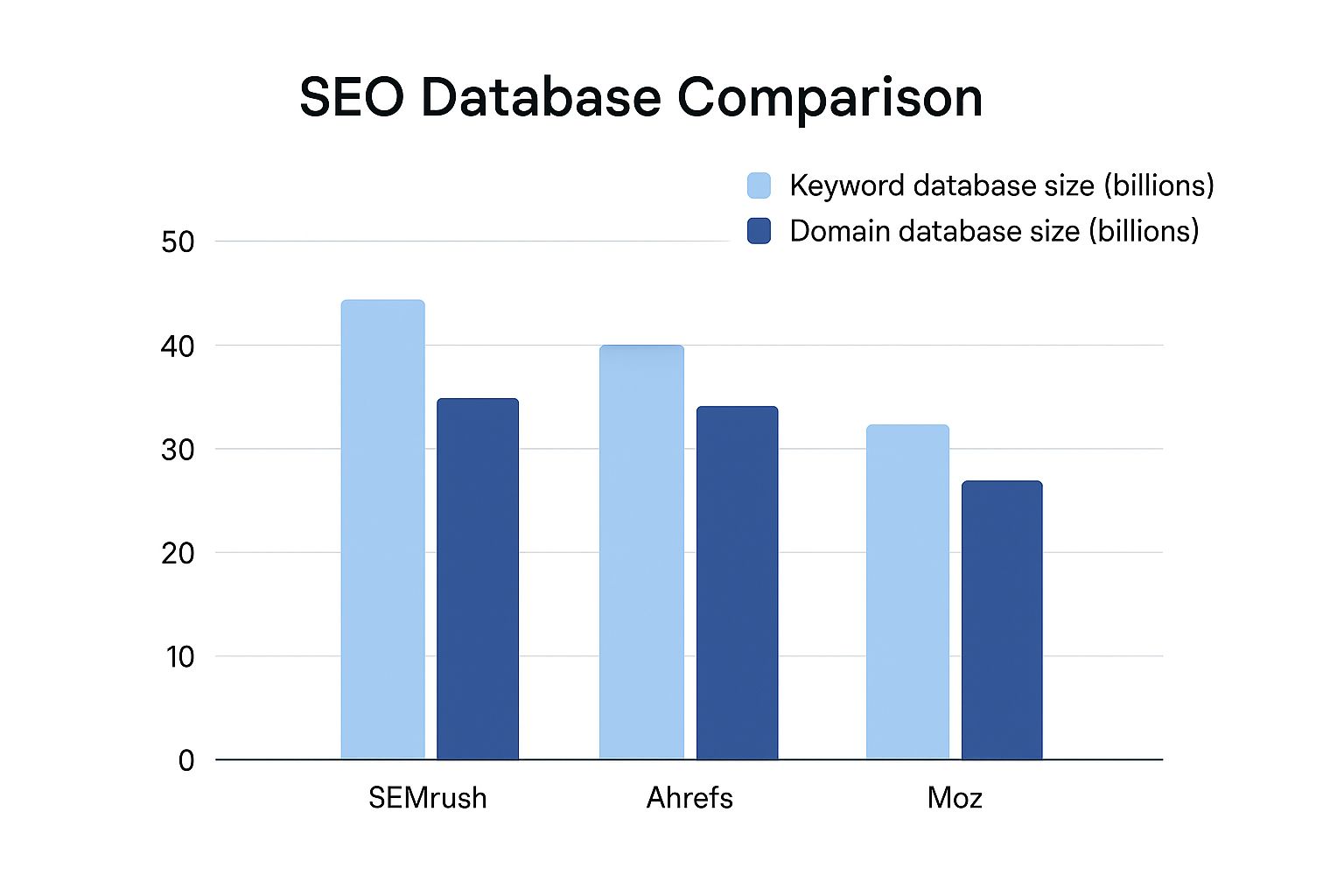
While Semrush is built to be your all-in-one marketing dashboard, Ahrefs earned its stripes with what’s widely considered the most powerful backlink analysis tool on the market.
Moz, a true veteran in the SEO space, is loved for its clean, user-friendly design.
Semrush vs. Ahrefs vs. Moz: Feature Comparison Table
| Comparison Point | Semrush | Ahrefs | Moz |
|---|---|---|---|
| Key Features | All-in-one suite with SEO, Content, Advertising, and Social Media toolkits. | Best-in-class backlink index, Site Explorer, Keywords Explorer, Content Explorer. | Keyword Explorer, Link Explorer, Site Crawl, Local SEO tools. |
| Data Accuracy | Excellent keyword data and traffic estimations. Very reliable. | Industry-leading backlink crawler, considered the most accurate for link data. | Solid and reliable data, though its database size is smaller than competitors. |
| User Interface | Feature-packed and well-organized, but can have a learning curve for new users. | Clean and data-focused, which can feel a bit complex for newcomers but is loved by pros. | Hands down the most intuitive and beginner-friendly platform of the three. |
| Pricing | Starts at $139.95/mo. Good value for an all-in-one tool. | Starts at $99/mo. Can get expensive with higher data usage due to credit system. | Starts at $99/mo. Good entry-level pricing. |
| Unique Strengths | The sheer breadth of its toolkit. The Keyword Magic Tool is market-leading. | The gold standard for backlink analysis and competitive link research. | Extremely user-friendly with great educational resources and solid local SEO features. |
| Verdict: Best For | Marketers and businesses wanting one tool to do it all. | SEOs and agencies who live and breathe link building and off-page SEO. | Beginners, small businesses, and those focused on local SEO. |
Your choice really boils down to your primary need.
Semrush is for the marketer who wants a complete arsenal.
Ahrefs is for the specialist who obsesses over link building, and our link-building services often leverage its power. Moz is for the business owner who needs powerful tools without a steep learning curve.
You can also check our detailed guide about – SEMrush vs Ahrefs
The Brutally Honest Pros and Cons
No Semrush review is complete without a balanced look at the good and the bad. Here are the Semrush pros and cons based on years of daily use.
Pros: Where Semrush Wins
- The Ultimate All-in-One Toolkit: This is its biggest advantage. You get tools for SEO, PPC, content marketing, and social media all under one roof. It eliminates the need for 5-6 different subscriptions.
- Market-Leading Keyword Research: The Keyword Magic Tool is simply phenomenal. Its massive database and intuitive filters make finding content opportunities faster and more effective than any other tool I’ve used.
- Powerful Competitor Analysis: Semrush makes it almost too easy to spy on your competition. You can see their top keywords, best-performing pages, and even their ad copy, giving you a clear roadmap to beat them.
- Actionable Site Audits: The Site Audit tool turns complex technical SEO into a simple, prioritized to-do list. Fixing the “Errors” it finds is often the fastest way to see a jump in rankings.
Cons: Where Semrush Could Improve
- The Learning Curve is Real: With so many features, the dashboard can feel overwhelming for a true beginner. It takes time to learn where everything is and how to use it effectively.
- “One User Per Plan” Limitation: The standard plans (Pro and Guru) only come with one user seat. Adding additional users gets expensive quickly, which can be a pain point for growing teams.
- The Cost: Let’s be honest, it’s a premium tool with a premium price tag. For freelancers or small businesses on a tight budget, the monthly cost can be a significant commitment.
- Backlink Data Isn’t Quite Ahrefs-Level: While Semrush’s backlink tools are very good and constantly improving, Ahrefs is still widely considered the gold standard for having the largest and most up-to-date backlink index.
Frequently Asked Questions (FAQs)
Is Semrush data accurate?
Yes, Semrush is widely considered one of the most reliable all-in-one SEO platforms. While no third-party tool can perfectly mirror Google’s private data, Semrush gets impressively close. Multiple studies have shown its keyword volume numbers align closely with data from Google Search Console, making it a trustworthy source for strategic decisions.
Can a total beginner use Semrush?
Absolutely, but with a realistic approach. There is a learning curve. My advice: don’t try to master it all at once. Start with one tool, like the Site Audit, to find and fix easy technical issues.
Then move to the Keyword Magic Tool. Semrush also offers the excellent Semrush Academy with free courses to get you up to speed fast.
Is Semrush better than Ahrefs?
It’s not about “better,” it’s about “better for you.” Semrush is better if you need an all-in-one marketing suite for keyword research, content creation, and competitor analysis. Ahrefs is better if your primary focus is on link building and backlink analysis, as its backlink index is considered the industry’s best.
How much does Semrush cost per month?
Semrush pricing starts with the Pro plan at $139.95/month. The Guru plan is $249.95/month, and the Business plan is $499.95/month. They offer a discount for annual billing.
Is there a free version of Semrush?
Yes, Semrush offers a free account with very limited functionality (e.g., 10 searches per day). It’s fine for occasional checks but not for serious SEO work. The best approach is to use the free trial to get full access to a paid plan for a limited time and test its true capabilities.
What is Semrush used for?
Semrush is used for a wide range of digital marketing tasks, including:
- Keyword Research
- Competitor Analysis
- Technical SEO Audits
- Rank Tracking
- Backlink Analysis
- Content Marketing Planning
- PPC Campaign Research
Final Verdict: Is Semrush Worth It in 2025?

After digging deep into every feature, running it through a real-world test, and stacking it against the competition, we’re back to the big question that started this Semrush review: Is it really worth the money?
The answer is a definite yes, but with a crucial caveat. Semrush is for people who are serious about getting real, measurable results. This isn’t just another piece of software; it’s a growth engine. If you’re ready to stop guessing and start building your strategy on a foundation of solid data, the ROI is impossible to ignore.
The real magic of Semrush is that it connects all the dots. It’s the central command center that links your keyword research to your content creation, your site audits to your rank tracking, and your strategy to your competitor’s every move.
- For the ambitious blogger or small business owner: The Pro plan is your secret weapon.
- For the growing agency or in-house marketing team: The Guru plan is a no-brainer.
Look at it this way: Semrush is an investment, not an expense. As our case study proved, a smart approach using this tool can boost organic traffic by over 175% in just six months. When you consider the value of that traffic to your business, the subscription pays for itself many times over.
If you’re ready to stop guessing and start growing, Semrush is the single best investment you can make for your digital marketing. It delivers the clarity, the data, and the power you need to not just compete, but to truly dominate your niche.
Your next step is simple. Don’t just take my word for it.
Start your free trial with a clear mission. Use the strategies from this guide to run a Site Audit, spy on your top competitor, and map out your next ten blog posts. See the data for yourself, and then you’ll know for sure.