

If I had to sum it up in one sentence, here it is: Ahrefs is a powerhouse SEO platform for professionals who need the absolute best backlink data and competitor analysis on the market.
It’s expensive, no doubt. But for agencies, in-house SEO teams, and serious marketers who live and die by organic growth, the investment is almost always worth it.
Is Ahrefs the Right SEO Tool for You?
Picking an SEO tool is a bit like choosing a vehicle for a road trip. A basic sedan (like a free or budget tool) will get you from A to B, sure. But it’s not built for the tough stuff. It lacks the power, comfort, and advanced navigation you need for a truly complex journey.
Ahrefs is the high-performance SUV of the SEO world. It’s tough, packed with sophisticated features, and built to handle any terrain you throw at it.
This review will show you how Ahrefs acts as a command center for your entire marketing strategy. It goes way beyond simple keyword tracking to give you deep intelligence on why your competitors are outranking you. Its magic lies in its massive index of backlinks and a surprisingly clean interface that makes complex data feel accessible.
The Ahrefs Verdict at a Glance
So, is it worth the hefty price tag?
For many of us in the trenches, the answer is a firm yes.
Ahrefs has a knack for uncovering strategic opportunities that other tools just seem to miss. It helps you nail down the answers to critical questions like:
- Who is linking to my competitors but not to me?
- What content is actually driving traffic in my niche?
- Are there sneaky technical issues on my site holding me back?
The platform’s main dashboard gives you a clean, immediate snapshot of your site’s health.
This view instantly shows you core metrics like Domain Rating, referring domains, and organic traffic, so you can track progress without digging around for hours.
The biggest hurdle, however, is its premium price and the credit-based system, which can feel restrictive for freelancers or small businesses.
But if your business depends on gaining an edge through search, the ROI usually speaks for itself. Our agency relies on these insights to build powerful, data-driven strategies.
To see what that looks like in action, check out our approach to professional SEO.
To help you decide if it’s right for you, here’s a quick rundown.
Ahrefs Quick Verdict
This table boils it all down to the essentials. Think of it as the cheat sheet for deciding if Ahrefs fits your needs and budget.
| Aspect | Summary |
|---|---|
| Best For | SEO agencies, in-house marketing teams, and content marketers obsessed with growth. |
| Key Strength | Unmatched backlink index and competitor analysis capabilities. It’s the gold standard. |
| Main Drawback | Premium pricing and a credit system that can be limiting on lower-tier plans. |
| Final Recommendation | Highly Recommended for anyone who needs top-tier data to drive their SEO strategy. |
Ultimately, Ahrefs is an investment. If you’re serious about competing in organic search, it’s one of the best you can make.
What Exactly Is Ahrefs and Who Uses It?
So, what’s the deal with Ahrefs?
At its heart, it’s a powerful, all-in-one SEO toolkit.
But thinking of it as a single tool is selling it short. It’s more like a complete orchestra for your digital marketing, providing all the data you need to understand and improve how your website performs in search engines.

Ahrefs first hit the scene back in 2011, quickly building a reputation for having one of the best backlink checkers in the business.
Over the years, it’s evolved into a full-blown suite of tools that touches on nearly every part of SEO. It’s like your own private intelligence agency, showing you exactly what your competitors are up to and highlighting your best shots at growth.
This comprehensive approach makes it an absolute must-have for a specific crowd of professionals—the ones who live and breathe deep, accurate data to get results.
Identifying the Primary Ahrefs User
While anyone can use Ahrefs, its depth and price tag make it a serious tool for serious people.
It’s built for those who need to make data-backed decisions every single day to gain a competitive edge in organic search.
This user base is surprisingly diverse, which speaks to the tool’s flexibility.
For example, a huge chunk of its customers are in the United States (about 36%), and the marketing and advertising industry makes up its biggest client base at around 20%. You can dig into more of this data over at enlyft.com.
The typical Ahrefs power user usually falls into one of three buckets:
- SEO Agencies: These teams are the bread and butter of the Ahrefs community. They’re juggling multiple client campaigns at once—from technical audits and keyword research to complex link-building pushes. Ahrefs gives them an efficient way to track progress and prove ROI across their entire client list. We’ve seen firsthand how these insights can completely turn a campaign around, as you can see in our client case studies.
- In-House Marketing Teams: Corporate marketing departments at mid-to-large companies lean on Ahrefs to protect and expand their brand’s online footprint. They’re constantly tracking competitors, sniffing out new content ideas, and making sure their site stays technically sharp. For them, Ahrefs is the central command for all things SEO.
- Freelance SEO Consultants and Content Marketers: Independent pros count on Ahrefs to deliver top-tier results for their clients. The tool’s reliable data gives them the confidence to build killer strategies, whether that means finding low-competition keywords or uncovering juicy backlink opportunities.
Key Takeaway: Ahrefs isn’t a casual tool you poke around in on a Sunday afternoon. It’s a professional-grade platform for people whose paychecks are directly tied to how well they perform in organic search. Its features are designed to solve complex problems and uncover strategic advantages that simpler tools just can’t see.
Figuring out if you fit one of these profiles is the first step in deciding if Ahrefs is right for you. If you see yourself in these descriptions, the platform’s advanced features will probably feel like a perfect fit, not an overwhelming expense.
A Look Inside the Ahrefs Toolkit

Ahrefs isn’t just one tool; it’s a full suite of specialized instruments that work together.
Think of it less like a single hammer and more like a master mechanic’s toolbox.
Each piece serves a distinct, vital purpose.
In this part of our Ahrefs review, we’re going to pop the hood and look at the five core modules that make up the platform.
Understanding these five pillars—Site Explorer, Keywords Explorer, Site Audit, Rank Tracker, and Content Explorer—is how you unlock what Ahrefs can really do.
We’ll go beyond a simple feature list and show you how they solve real-world SEO challenges.
#1 Site Explorer: The Competitor Intelligence Hub
Site Explorer is the heart and soul of Ahrefs.
Imagine getting a complete blueprint of any competitor’s website, showing you exactly how they get their traffic and where their authority comes from.
That’s what Site Explorer delivers.
You just plug in a domain, and it acts like a digital MRI, scanning the site to reveal its deepest SEO secrets. It’s the ultimate tool for reverse-engineering success.
Here’s a practical example: You can analyze a top competitor to build out your link-building strategy. Instantly, you see every single backlink pointing to their site, which you can then filter by Domain Rating (DR) to spot high-authority sites you could also get a link from. This turns a wild guessing game into a precise, data-driven mission.
The key metrics that give you an edge are:
- Backlink Profile: See every domain linking to a competitor, complete with DR and estimated traffic.
- Top Pages: Discover which of their pages attract the most backlinks and organic traffic.
- Outgoing Links: Analyze where your competitors are linking out to, which can reveal content partnerships and strategies.
- Anchors: See the exact anchor text used in their backlinks, giving you a peek into their keyword targeting.
For many SEOs, this tool alone is worth the price of admission.
#2 Keywords Explorer: Finding Your Next Big Win
Keywords Explorer is your compass for navigating the vast ocean of search queries. It does more than just spit out search volume; it helps you understand the intent and opportunity behind every keyword.
Think of it as a market research tool built for search. While Google Keyword Planner gives you the basics, Ahrefs provides a much richer context. It shows you not just how many people search for a term, but also how difficult it will be to rank and how many clicks you can realistically expect to get.
Let’s say you’re launching a new productivity app. You can use Keywords Explorer to find questions people are asking related to “time management software.” Ahrefs won’t just give you a massive list of ideas; it will also show you metrics like Keyword Difficulty (KD), which estimates how hard it will be to crack the top 10. You can filter for low-KD keywords to find some quick wins.
One of the most powerful features here is the “Parent Topic” metric. It tells you if you can rank for your target keyword by creating content for a broader topic, helping you build more authoritative pages that can rank for hundreds of related terms.
#3 Site Audit: Your Technical SEO Health Check
If Site Explorer is about looking at the competition, Site Audit is all about looking in the mirror.
This tool acts as your 24/7 technical SEO specialist, constantly crawling your website to find issues that could be tanking your rankings.
It scans for over 100 pre-defined SEO issues, from broken links and slow-loading pages to missing meta descriptions and duplicate content.
Without a tool like this, finding these problems would take hours of manual work or specialized expertise.
Getting your technical foundation right is a cornerstone of effective SEO. If you need a deeper dive into this, our guide on professional on-page SEO services can provide more context.
The report lays out the data in a clear, actionable format. It prioritizes issues by severity, so you know exactly what to fix first. For instance, it might flag a dozen pages with “404 not found” errors, allowing you to quickly redirect them and reclaim any lost link equity.
You can check details in the below image of Site Audit feature of Ahrefs.

#4 Rank Tracker: Monitoring Your Progress
You can’t improve what you don’t measure.
Rank Tracker is Ahrefs’ solution for keeping an eye on your most important keywords over time. It gives you a clear picture of your performance in the search results, showing you whether your hard work is actually paying off.
The tool lets you track a list of keywords across multiple locations and devices (desktop and mobile).
It provides daily or weekly updates, so you can quickly react to any big drops or celebrate upward trends.
What makes Rank Tracker especially useful are its competitor features.
You can add your top rivals and see how your rankings stack up against theirs for the same set of keywords.
The “share of voice” metric shows what percentage of traffic for your target keywords is going to you versus them—a powerful benchmark for your campaign’s success.
Now with the LLMs in the picture you need to also monitor and understand your visibility in LLMs for which Ahrefs have launched Brand Radar. Know more about it below.
#5 Brand Radar

Remember when tracking your Google rankings was enough? Well, those days are gone.
With ChatGPT, Claude, Gemini, Perplexity and other AI assistants becoming the new search engines for millions of users, you need to know if these AI models are mentioning your brand—and what they’re saying about you.
That’s where Brand Radar comes in.
Think of it as your early warning system for the AI age.
This tool monitors how often your brand appears in AI-generated responses across major language models.
It’s like having a spy in the room when someone asks ChatGPT about your industry. You get to see if you’re being recommended, ignored, or worse—if your competitors are stealing the spotlight.
Here’s what makes this a game-changer:
AI Mention Tracking: See exactly when and how AI models reference your brand, products, or services in their responses.
Competitor Comparison: Track how often you’re mentioned versus your rivals. If an AI recommends three project management tools and you’re not one of them, you’ve got a problem.
Sentiment Analysis: It’s not just about being mentioned—it’s about being mentioned positively. The tool flags whether AI responses paint you in a good, bad, or neutral light.
Opportunity Alerts: Get notified when AI models start discussing topics where your brand should be present but isn’t. These are your content gaps in the AI ecosystem.
The real kicker? This data helps you understand what content you need to create to influence these AI models. Since LLMs train on web content, improving your visibility here means playing the long game—creating authoritative content today that shapes AI responses tomorrow.
For agencies and enterprise teams, this is becoming as critical as traditional SERP tracking. You can’t afford to be invisible in AI conversations when your competitors are getting recommended left and right.
#6 MCP Server: Your Custom SEO Command Center

Here’s where things get really interesting for the power users and tech-savvy teams.
The MCP (Model Context Protocol) Server is Ahrefs’ answer to the growing demand for AI-powered SEO workflows. It’s essentially a bridge that lets AI assistants like Claude directly access and work with your Ahrefs data in real-time.
Think of it as giving your AI assistant a backstage pass to all your SEO data. Instead of constantly copying and pasting between tools, you can have AI analyze, interpret, and act on your Ahrefs insights automatically.
This isn’t just another API—it’s way more sophisticated. Here’s what it unlocks:
Direct AI Integration: Connect Claude, ChatGPT (via plugins), or other AI tools directly to your Ahrefs account. Your AI assistant can pull fresh data, run analyses, and generate reports without you lifting a finger.
Custom Workflow Automation: Build complex SEO workflows where AI can monitor your rankings, analyze competitor moves, and even draft response strategies based on real-time Ahrefs data.
Natural Language Queries: Instead of clicking through menus, just ask your AI: “What backlinks did my competitor gain this week?” or “Find me low-competition keywords in the project management space.” The MCP Server translates these requests into Ahrefs queries and serves up the answers.
Bulk Analysis at Scale: Need to analyze 500 competitor domains? The MCP Server lets AI assistants process massive amounts of Ahrefs data and synthesize it into actionable insights—something that would take humans days to complete.
For agencies, this is a complete game-changer. Imagine having an AI assistant that can instantly pull together competitive intelligence reports for client calls, or automatically flag when a competitor’s link-building campaign is heating up.
The setup requires some technical chops (or a developer on your team), but once it’s running, it’s like having a tireless SEO analyst working 24/7. We’re already seeing agencies use this to 10x their productivity on research and reporting tasks.
#7 AI Content Helper: Your Writing Co-Pilot on Steroids

Let’s address the elephant in the room: AI is changing content creation forever.
Ahrefs’ AI Content Helper isn’t just another ChatGPT wrapper—it’s built specifically for SEO content that actually ranks.
This tool bridges the gap between AI’s creative capabilities and SEO’s demand for strategic, data-driven content.
It’s like having a content strategist, SEO expert, and copywriter rolled into one assistant that actually understands what Google wants.
Here’s where it gets really clever:
SERP-Informed Writing: The tool analyzes the top 10 ranking pages for your target keyword and extracts the key topics, questions, and semantic patterns that Google rewards. Your AI-generated content isn’t just grammatically correct—it’s strategically aligned with ranking signals.
Real-Time Optimization Scoring: As you write (or as AI writes for you), you get a live optimization score showing how well your content matches search intent. It’s like having an SEO expert looking over your shoulder, but less annoying.
Competitor Gap Analysis: The helper identifies topics your competitors cover that you’re missing. It literally shows you the specific subtopics and questions that could be the difference between page one and page two.
Natural Internal Linking: Based on your existing content, it suggests contextual internal links that make sense both for users and search engines. No more forcing awkward links just to hit a quota.
What really sets this apart from generic AI writing tools is the integration with Ahrefs’ massive dataset.
When the AI suggests a topic or keyword, it’s backed by real search volume, competition data, and ranking difficulty scores. This is exactly where new AI content writing tools like outrank. so , blogbuster, seobotai are lacking.
You’re not just creating content—you’re creating content with a data-backed strategy.
The workflow is pretty slick too.
Start with keyword research in Keywords Explorer, feed that into the AI Content Helper, and it generates a detailed outline based on what’s actually ranking. You can then use AI to write the first draft, with the tool ensuring every section aligns with SEO best practices.
For content teams drowning in production demands, this is a lifesaver.
I’ve seen agencies triple their content output without sacrificing quality—because the AI is trained on what actually works in search, not just what sounds good.
Fair warning though: This isn’t a “set it and forget it” solution.
The best results come from treating AI as your co-pilot, not your replacement. Use it to handle the heavy lifting of research and first drafts, then add your unique insights, expertise, and brand voice to create something truly valuable.
You can check many more AI Content Writing Tools here.
#8 Content Explorer: The Idea Generation Machine
Finally, there’s Content Explorer. This tool is a massive, searchable database of billions of web pages, designed to help you find proven content ideas and spot link-building opportunities.
Imagine you want to write a blog post about “remote work.” Instead of guessing what might do well, you can use Content Explorer to find articles on that topic that have already generated thousands of social shares and backlinks.
You can break down what makes these top-performing pieces successful and then create something even better. The tool lets you filter results based on specific criteria, like:
- Organic traffic: Find articles that are already ranking well.
- Referring domains: Identify content that has attracted a ton of backlinks.
- Social shares: See what topics are resonating on platforms like Twitter and Pinterest.
- “Broken links” filter: This is a goldmine for link building. It shows you popular articles with dead outbound links, creating a perfect opportunity to reach out and suggest your own content as a replacement.
Together, these five tools form a cohesive system that covers nearly every part of a modern SEO campaign. Each module is powerful on its own, but their true strength comes out when you use them together to build a complete, informed strategy.
The Data Engine That Powers Ahrefs

So, what makes the insights you pull from Ahrefs feel so darn reliable? The secret lies in the colossal data operation humming away behind the scenes.
This isn’t just another tool piggybacking on someone else’s data; Ahrefs runs its own massive web crawler, AhrefsBot, which is out there exploring the web 24/7.
Think of it as the SEO world’s version of the Library of Congress.
It’s constantly indexing new pages, mapping out the connections between sites, and cataloging every little change.
This relentless data gathering is what allows Ahrefs to serve up intelligence that’s not just deep, but also incredibly fresh. Its real power isn’t just in the flashy features—it’s in the sheer scale of the information it commands.
The Numbers Behind the Engine
To really get a feel for what Ahrefs is working with, you have to look at the numbers. And frankly, they’re staggering. We’re not talking about a big database; we’re talking about one of the most substantial data sets in the entire digital marketing industry.
This is the kind of scale that lets you analyze backlink profiles and keyword opportunities with genuine confidence. Ahrefs is tracking roughly 35 trillion external backlinks and 27.2 trillion internal backlinks. Its index is home to an incredible 456.5 billion web pages, and its keyword database contains around 28.7 billion keywords.
What’s really interesting is that Ahrefs filters this massive keyword list, considering only about 26.09% of them “high-quality.” That tells you they prioritize relevance over just throwing huge, raw numbers at you. This rock-solid data foundation is what makes every single tool in the Ahrefs suite work so well.
Key Insight: Any SEO tool is only as good as the data it sits on. Ahrefs invests a fortune in its own crawling tech, giving it a level of control and freshness that tools relying on third-party data just can’t match. That’s the “secret sauce” behind its trusted metrics.
Why Data Scale Matters for Your SEO
Okay, but why should you care about all these trillions and billions? Because a bigger, fresher index means the insights you’re getting are a much more accurate reflection of the web right now.
- More Comprehensive Backlink Analysis: A bigger index means Ahrefs finds more backlinks—including the new, obscure, or niche ones that smaller crawlers completely miss. This is absolutely critical for anyone serious about https://visibilityventures.co/services/link-building.
- Greater Keyword Opportunity Discovery: With billions of keywords at your fingertips, you can unearth long-tail queries and spot emerging topics long before your competitors even know they exist.
- Accurate Competitor Benchmarking: When you run a competitor analysis, you’re seeing a much more complete picture of their strategy, not just a tiny, incomplete snapshot.
This obsession with building and maintaining a world-class data engine is what truly sets Ahrefs apart. It’s what justifies its premium price tag—because the very foundation it’s built on is simply bigger and more reliable than almost anything else out there.
Breaking Down Ahrefs Pricing and Plans
Let’s talk money. Cost is always a huge factor in any serious tool review, and with Ahrefs, it’s important to look beyond the sticker price. The platform uses a tiered subscription model, and each plan is really built for a different kind of user. Picking the right one means matching your actual needs with the features and data limits you get, so you’re not overpaying or hitting frustrating walls halfway through a project.
Ahrefs has four main plans: Lite, Standard, Advanced, and Enterprise. As you move up the ladder, you unlock more projects, deeper data, and higher usage limits for all the core tools. The whole structure is designed to scale with you, whether you’re a solo consultant or a big agency juggling dozens of clients.
This snapshot gives you a quick visual on the kinds of data points Ahrefs is constantly tracking. It shows things like the breakdown of dofollow vs. nofollow links and, more importantly, the difference between total backlinks and unique referring domains.
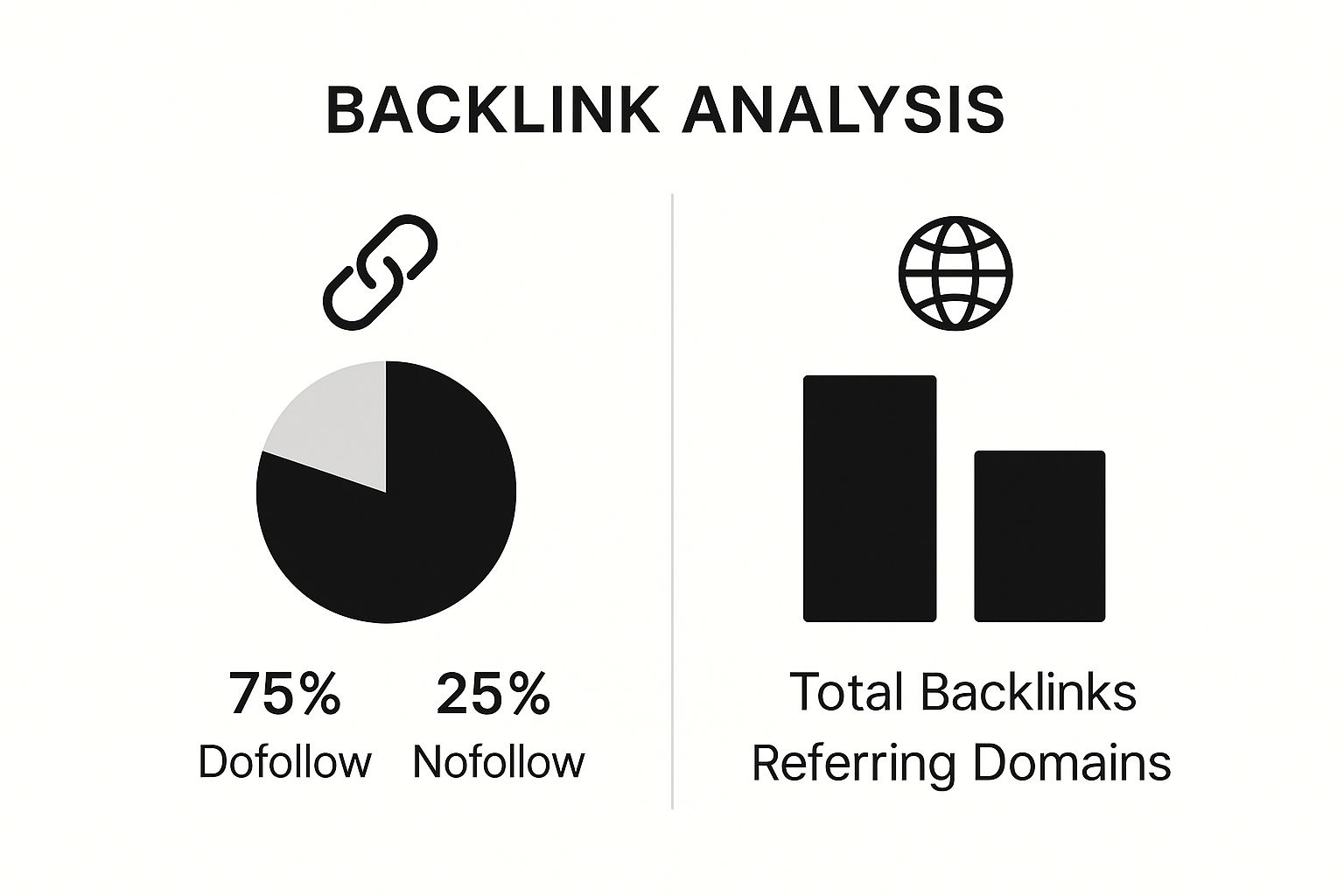
That last point is key. The image drives home the idea that a huge number of backlinks isn’t nearly as valuable as getting links from many different, high-quality websites. That’s a core concept for any effective link building campaign.
To make the choice clearer, here’s a table that lays out what you get with each plan.
Ahrefs Pricing Plan Comparison
| Feature/Limit | Lite | Standard | Advanced | Enterprise |
|---|---|---|---|---|
| Price (Monthly) | $99 | $199 | $399 | Custom |
| Users | 1 | 1 | 3 | Custom |
| Tracked Keywords | 750 | 2,000 | 5,000 | 10,000 |
| Site Audit Credits | 100,000/mo | 500,000/mo | 1.5M/mo | 5M/mo |
| Site Explorer Reports | 100/day | 500/day | 750/day | 1,000/day |
| Content Explorer | Limited | Standard | Advanced | Advanced |
| Historical Data | Limited | 6 Months | 2 Years | Unlimited |
| API Access | No | No | No | Yes |
This comparison should give you a good sense of where the lines are drawn. Now, let’s dig into who each plan is really for.
Ahrefs Lite Plan
The Lite plan is your entry point.
It’s perfect for solo entrepreneurs, freelancers, and small website owners who are just starting to get serious about SEO.
You get access to all the core tools, but there are guardrails on how much data you can pull. For instance, you can only track a limited number of keywords and run fewer site audit crawls.
Think of it as a starter kit. It’s got enough power to handle competitor research, find some keyword opportunities, and keep an eye on your backlink profile. But if you’re managing multiple client sites or have a massive website, you’ll probably start feeling the data caps pretty fast.
Ahrefs Standard Plan
The Standard plan is often the sweet spot for growing businesses and small marketing teams. It dramatically bumps up the data allowances from the Lite plan, letting you track more keywords, analyze more competitors, and even look at historical data going back six months.
This is the plan where you can start doing real, in-depth strategic work. The increased limits in Site Explorer, for example, mean you can run a much more thorough backlink analysis without worrying about using up your daily reports. It’s ideal for anyone who has moved past the SEO basics and needs more robust data to power their campaigns.
Key Takeaway: The Standard plan strikes the best balance between features and cost for most small to medium-sized businesses. It unlocks enough data to do meaningful analysis without the enterprise-level price tag.
Advanced and Enterprise Plans
The Advanced plan is built for agencies and larger in-house teams that are starting to scale. The biggest jump here is the sheer volume of data you can get your hands on, including way more tracked keywords, more site audit credits, and access to more historical data. This tier is for the power users who live in the tool every day, managing complex campaigns for multiple high-stakes projects.
Finally, the Enterprise plan is for large organizations with massive SEO needs. It offers the highest possible limits, API access for building custom integrations, and dedicated support. This is the top-shelf solution for businesses where SEO is a core, high-investment marketing channel.
Choosing the right plan is all about managing your budget effectively. For a deeper look at how agencies build their service costs around tools like Ahrefs, you might find our breakdown of SEO pricing models helpful. It’ll give you a better sense of the value you should expect from your investment.
An Honest Look at Ahrefs Pros and Cons
Look, no tool is a magic wand and if we’re going to do an honest Ahrefs review, we need to look at the good, the bad, and the pricey.
Ahrefs often feels like the gold standard in SEO, but before you commit to a subscription, it’s critical to weigh its killer features against some pretty significant drawbacks.
This isn’t about picking a winner. It’s about helping you figure out if the tool’s trade-offs make sense for your specific needs, budget, and the way you work. Let’s get into where Ahrefs absolutely crushes it and where it might just fall flat for you.
The Upside: What Ahrefs Does Best
Ahrefs has earned its top-tier reputation for a few key reasons, but three areas really make it stand out from the crowd.
- Industry-Leading Backlink Index: This is Ahrefs’ original claim to fame, and honestly, it’s still their biggest flex. Their massive, proprietary database of backlinks is ridiculously comprehensive and fresh. It gives you the most accurate picture you can get of any website’s link profile. For digging into competitor strategies and building your own links, this data is simply best-in-class.
- Exceptional User Experience: For a tool that handles an insane amount of data, the Ahrefs interface is surprisingly clean, intuitive, and zippy. Complex reports are boiled down into easy-to-read charts and graphs, making it simple to find actionable insights without getting buried in spreadsheets. This thoughtful design saves a ton of time.
- World-Class Educational Resources: Ahrefs invests a huge amount of effort into educating its users and the entire SEO community. Their blog and YouTube channel are genuine treasure troves of high-quality, practical content. They don’t just teach you how to use their tool; they teach you how to be a better marketer. That commitment adds a ton of value that goes way beyond the software itself.
The Downside: Where Ahrefs Can Be Challenging
As powerful as it is, the platform has a couple of potential deal-breakers.
These are the main hurdles people run into, and they’re worth thinking about.
The most obvious one is the premium price point.
Let’s be real—Ahrefs is one of the more expensive tools out there, which can be a major roadblock for freelancers, small businesses, or anyone on a tight budget.
Their success has allowed them to command this price; the company blew past $100 million in Annual Recurring Revenue and now serves over 50,000 paying customers.
That kind of growth, which you can read more about at inblog.ai, reflects its powerhouse market position.
On top of that, the introduction of a credit-based system adds another layer of complexity to the monthly subscription. If you’re on a lower-tier plan, you have to watch your credits like a hawk, since every report you pull eats into your allowance. It can feel restrictive and creates a bit of a learning curve as you figure out how to get your work done without having to buy expensive top-ups.
Data Discrepancies: A common point of friction is that Ahrefs’ organic traffic estimates can sometimes be wildly different from what you see in your own Google Search Console. While every third-party tool is just giving an estimate, some users find Ahrefs’ numbers to be a bit inflated. It’s essential to treat them as directional indicators, not gospel truth.
You can check Ahrefs Alternatives here.
Ahrefs FAQs: Your Questions Answered
Alright, let’s wrap this up by tackling some of the questions that always come up when people are kicking the tires on Ahrefs. These are the things people wonder about right before they decide to jump in, so let’s clear them up.
How Accurate Is Ahrefs Data?
They run their own massive web crawler, so their backlink index is one of the most comprehensive and up-to-date you’ll find.
Now, for organic traffic estimates, it’s a different story. You’ll almost certainly see numbers that don’t perfectly match what’s in your Google Search Console. That’s totally normal.
Think of Ahrefs metrics as incredibly reliable directional guides, not absolute truths.
If Ahrefs shows a competitor’s traffic is trending up, you can bet it is. The exact number might be off, but the trend itself is what you need for smart strategic planning.
Is Ahrefs Better Than Semrush?
Ahrefs is the specialist. It absolutely shines when you need to do a deep dive into backlink profiles and competitor research. Many SEO pros swear by its clean interface and the sheer depth of its link data.
Semrush is the all-rounder. It’s a much broader platform, packing in tools for PPC, social media, and content marketing right alongside its very capable SEO features.
If your world revolves around link building and pure SEO intelligence, you’ll probably lean towards Ahrefs. But if you’re a marketer wearing multiple hats, Semrush’s wider toolkit might be the better fit.
There’s a ton of great head-to-head comparisons online where SEOs pit these two giants against each other using real website data. It’s worth checking those out to see how they perform in specific scenarios that match your own.
Can Beginners Use Ahrefs Effectively?
The user interface is slick and clean, but the amount of data it throws at you can feel like drinking from a firehose at first.
The good news? Ahrefs knows this.
They’ve poured a ton of resources into creating some of the best educational content in the entire industry.
Their blog and YouTube channel are absolute gold mines for learning the ropes.
A beginner who’s actually willing to put in the time to learn will find Ahrefs to be an amazing teacher. The Lite plan is a perfect place to start, giving you access to the core tools without the hefty price tag of the bigger plans.
Ready to see what data-driven insights can do for your organic growth? At Visibility Ventures, we use powerful tools like Ahrefs to craft SEO strategies that deliver real, measurable results.
Start with a free, no-obligation SEO audit and let’s uncover your biggest opportunities together.